

Executive research findings

Tooth wear prevalence in older adults is an important topic as more Americans retain their natural teeth later in life.
Research shows that tooth wear becomes more common with age, but recent U.S. data specifically measuring the condition in adults aged 65 and older remain limited.
Most American studies published between 2021 and 2026 rely on older National Health and Nutrition Examination Survey (NHANES) data rather than new nationwide clinical examinations.
This makes it difficult to determine exactly how many older adults currently experience moderate or severe tooth wear.
The American Dental Association (ADA) cites historical NHANES data indicating that signs of erosive tooth wear may affect up to 80% of U.S. adults.
A separate analysis found moderate-to-severe tooth wear in 12.1% of adults.
These figures are not contradictory: they use different definitions and severity thresholds, and neither should be interpreted as a current Greenville-specific prevalence estimate.
Age nevertheless matters. A best-evidence consensus review concluded that tooth-wear prevalence increases with age, although the biological impact varies considerably between patients and severe wear does not automatically require treatment.
The evidence supports considering full-mouth rehabilitation when significant tooth damage affects chewing, appearance, or comfort and the underlying causes of wear can be managed.
Age or a wear score alone should not determine whether extensive treatment is needed.
For Greenville, South Carolina, the demographic relevance is substantial. Greenville County had an estimated 583,125 residents in 2025, up 11.0% from its 2020 population base, and 18.7% were aged 65 or older.
South Carolina’s public oral-health dashboard tracks adult indicators such as dental visits, tooth decay and total tooth loss, but the state resources identified in this review do not provide a Greenville-specific clinical prevalence estimate for tooth wear.
Consequently, local burden should not be presented as though it has been directly measured.
What prevalence data actually show
“Tooth wear” is an umbrella clinical concept involving irreversible loss of dental hard tissue through interacting chemical and mechanical processes. Erosive tooth wear specifically involves acid-related dissolution that is not caused by bacterial acids.
The ADA identifies intrinsic acid exposure, particularly gastroesophageal reflux, and extrinsic sources such as carbonated beverages and acidic foods or drinks as major contributors; advanced erosion may expose dentin, produce hypersensitivity and eventually compromise teeth.
The headline U.S. prevalence numbers require careful interpretation:
| Evidence | Population and finding | Research interpretation |
| ADA summary of NHANES 2003–04 | Erosive tooth wear reported in up to 80% of U.S. adults | Captures a broad spectrum of detectable wear; not equivalent to severe disease requiring reconstruction. |
| U.S. NHANES analysis | 12.1% had moderate-to-severe tooth wear; affected adults averaged 3.4 surfaces with moderate-to-severe wear | More useful for estimating clinically meaningful burden, but based on historical NHANES examinations rather than current 2026 surveillance. |
| Best-evidence consensus | Tooth wear exceeds 30% by early adulthood and increases with age | Age is an exposure-time marker, but severity alone does not determine treatment need. |
The age-specific evidence is therefore weaker than the overall adult evidence.
The 2024 CDC Oral Health Surveillance Report provides contemporary national estimates for caries, tooth retention and edentulism but does not report tooth wear as one of its principal surveillance outcomes.
This is an important methodological limitation for any claim about the prevalence of pathological tooth wear specifically among Americans aged 65–74 or 75 and over.
At the same time, older Americans are increasingly retaining natural teeth.
CDC data for 2017–March 2020 found that approximately 11% of adults aged 65–74 and 20% of those aged 75 or older were completely edentulous, meaning most older adults in both age groups retained at least some natural dentition susceptible to cumulative wear.
Declining tooth loss can therefore increase the number of older people in whom clinicians must manage the combined effects of wear, existing restorations, caries and periodontal disease.
Why aging changes the clinical risk profile
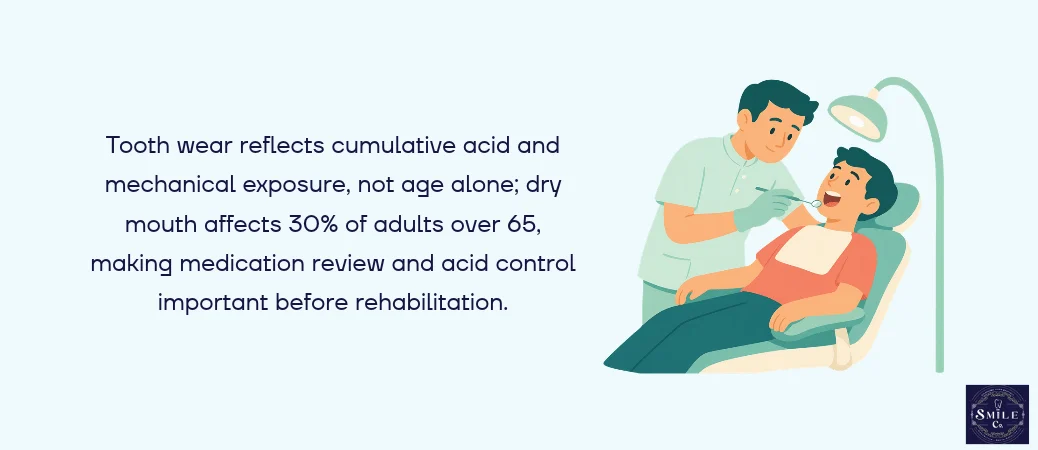
Age itself should not be treated as the cause of pathological wear.
Rather, decades of acid and mechanical exposure accumulate, while older adults may acquire factors that alter salivary protection, dental structure, restorative history and capacity for oral self-care.
The ADA notes that common geriatric oral-health issues include xerostomia, root and coronal caries and periodontitis, while physical or cognitive impairment can make effective home care more difficult.
Dry mouth is particularly relevant. The ADA estimates xerostomia in about 30% of people over 65 and as many as 40% of those over 80, commonly in association with medicines and systemic disease.
A U.S. NHANES analysis of 3,578 adults found that people taking one xerogenic medicine had 1.53 times the odds of tooth wear compared with non-users; the association appeared substantially related to subjective oral dryness.
This finding suggests a possible connection between medication-related dry mouth and tooth wear, although it does not establish that these medications directly cause tooth damage.
Acid exposure must also be investigated before reconstruction. The ADA identifies gastroesophageal reflux and frequent acidic-drink exposure as established erosive challenges.
In a U.S. adult analysis, among people already exhibiting moderate-to-severe wear, each additional daily sugar-sweetened acidic drink was associated with approximately 1.34 times as many affected surfaces after adjustment for other drink categories.
These associations support treating the underlying exposure as part of rehabilitation rather than simply covering worn surfaces restoratively.
For older adults, a dental assessment should consider tooth wear patterns, dry mouth, acid reflux, diet, grinding or clenching, remaining tooth structure, and existing restorations.
Managing excessive biting forces is especially important when planning long-term dental treatment. Research and patient guidance on night guards for dental implants also highlight why grinding pressure matters when protecting restorations.
Older patients are heterogeneous, from fully independent to frail or cognitively impaired, so chronological age is an inadequate stand-alone determinant of treatment intensity.
What the evidence means for full-mouth rehabilitation

Visible tooth wear does not automatically mean extensive treatment is necessary. Depending on the damage, restorative dentistry may help repair affected teeth and restore function without requiring full-mouth reconstruction.
The 2024 systematic review of oral-health-related quality of life found that restorative treatment of moderate-to-severe tooth wear generally improved patient-reported quality of life, whereas patients managed with counseling and monitoring showed little change after one year.
The effects of advanced dental problems can extend beyond physical symptoms. Research into the emotional effects of tooth loss also illustrates how changes in oral health may affect confidence, eating habits, and social interactions.
When severe wear occurs alongside tooth loss, dental implants may be considered for replacing missing teeth as part of a broader restorative plan.
They do not, however, replace the need to evaluate and preserve natural teeth that remain healthy.
Importantly, only six eligible studies were identified and the non-randomized studies generally had a high risk of bias.
The strongest justification for rehabilitation is clinically significant tooth damage that affects chewing, appearance, or comfort, rather than tooth wear prevalence alone.
A 2021 prospective study followed 1,269 direct resin-composite restorations in 34 patients undergoing full-mouth rehabilitation for severe wear for an average of approximately 5.2 years.
Annual failure rates were no more than 2.2% for anterior restorations and 2.9% for posterior restorations; only 2.3% of all restorations experienced the study’s catastrophic failure category.
Molars and mandibular posterior restorations carried higher failure risks, indicating that full-mouth composite rehabilitation can work in the medium term but requires continuing maintenance, particularly posteriorly.
A 2024 prospective CAD/CAM study reached a similar conclusion about location-dependent maintenance. Twenty-two severe-wear patients received 568 indirect resin-based-composite restorations plus 200 direct veneers.
At up to 5.5 years, annual rates for failures requiring replacement or repair were approximately 0.29% in front teeth, 1.56% in premolars and 2.93% in molars.
When smaller chipping events were included, annual event rates rose to 0.53%, 2.42% and 6.11%, respectively. Chipping and adhesive fracture dominated the complications.
This posterior gradient has particular planning significance in older adults.
A 2026 randomized pilot study found a mean annual failure rate of 2.3% for direct composite versus 8.7% for indirect polymer-infiltrated ceramic-network restorations over four years, with posterior restorations significantly more likely to fail.
Oral-health-related quality of life nevertheless improved after treatment.
The study involved only 15 evaluable patients, with a median age of 54, so its findings should be regarded as hypothesis-generating rather than proof that direct composite is universally superior in elderly patients.
Material choice is therefore not reducible to “ceramic versus composite”.
A 2026 prospective study of 116 CAD/CAM hybrid-ceramic restorations in 49 severe-wear patients reported an estimated 88.0% three-year survival, with dislodgement and marginal chipping among the common repairable complications; chewing efficiency and aesthetics improved.
Collectively, these studies favor a strategy based on remaining tooth substance, load, location, reparability, patient maintenance capacity and operator experience rather than one universal full-mouth material.
The emerging clinical model is consequently minimally invasive and maintenance-oriented.
The purpose of rehabilitation is to restore function, form and patient comfort while sacrificing as little healthy tissue as possible. Patients with dry mouth or heavy biting forces, particularly on their back teeth, may need more frequent dental maintenance.
Even successful full-mouth rehabilitation can require periodic polishing, repairs, adjustments, or replacement of individual restorations.
Recent systematic-review evidence similarly concludes that minimally invasive full-mouth approaches generally show favorable clinical performance, while outcomes vary across materials and techniques.
Greenville implications and outlook beyond 2026
Greenville County has a growing population of older adults, making long-term dental health an important concern. However, available research does not provide a reliable tooth wear prevalence rate specifically for older residents of Greenville, SC.
National tooth wear statistics cannot be directly applied to Greenville because the available studies examine different populations, age groups, and levels of tooth damage.
For individuals whose teeth are severely damaged or missing, comprehensive options such as DuraSmile full-mouth restoration may be considered after a clinical evaluation.
This approach is different from treating mild or moderate tooth wear in otherwise healthy natural teeth.
Demand for age-oriented restorative dentistry is nevertheless likely to grow beyond 2026.
The U.S. Census Bureau reported that people aged 65 and over constituted 18.9% of the U.S. population in 2025 and projects the proportion to reach 23.4% by 2060.
Coupled with declining complete tooth loss, this means more people will reach advanced age with natural teeth and restorations that require long-term preservation, monitoring and, in selected patients, rehabilitation.
This is a demographic inference rather than a forecast of the prevalence of tooth wear itself.
The most defensible post-2026 research priorities are therefore longitudinal digital measurement of wear progression; nationally representative U.S. clinical surveillance with dedicated ≥65 and ≥75 age strata; studies specifically enrolling medically complex older adults rather than predominantly middle-aged rehabilitation patients; longer comparisons of direct composite, adhesive CAD/CAM and ceramic strategies; and greater use of patient-reported outcomes alongside restoration survival.
Current studies demonstrate that full-mouth rehabilitation can perform well and improve quality of life, but they do not yet provide strong geriatric-specific evidence permitting a single preferred material or protocol for aging adults.
Research conclusion

The evidence supports three central conclusions. First, tooth wear is common and increases with age, but contemporary U.S. prevalence data specifically for adults aged 65+ are surprisingly weak; frequently cited national estimates still originate from historical NHANES examinations.
Second, aging changes the treatment environment through cumulative exposure, xerostomia, polypharmacy, reflux, competing caries and periodontal risks, and variable capacity for self-care, not simply through chronological age.
Third, modern full-mouth rehabilitation is increasingly based on conservative adhesive reconstruction plus lifelong risk control and maintenance rather than routine aggressive full-coverage preparation.
For research concerning Greenville, South Carolina, the strongest evidence-based position is therefore not to claim a local prevalence percentage that has never been directly measured.
Instead, Greenville should be viewed as a growing older-adult population in which the national evidence identifies a plausible and clinically important burden, while local epidemiological measurement remains needed.
For patients with severe tooth damage or multiple missing teeth, recognizing the signs you need full-mouth implants may help guide a discussion about treatment options.
However, recent studies show that reconstruction requires ongoing maintenance, particularly for restorations on back teeth, and evidence specifically involving older adults remains limited.
References
Dental Erosion | American Dental Association
Tooth Wear: Best Evidence Consensus Statement – PubMed
U.S. Census Bureau QuickFacts: Greenville County, South Carolina
2024 Oral Health Surveillance Report – CDC
About Tooth Loss | Oral Health | CDC
Aging and Dental Health | American Dental Association
Clinical performance of minimally invasive full-mouth … – PubMed
Global Older Adult Population Projected to Nearly Double by 2060