

Research scope and evidence base
This guide examines sedation dentistry utilization rates and safety in oral surgery: how often moderate and deep sedation/general anesthesia (GA) are used, what the best available adverse-event data show, how regulation has changed, and the local conditions shaping practice in Greenville County, South Carolina.
The evidence window is 2021 to 2026, supplemented by earlier large case series where longer follow-up or larger cumulative volume is needed to characterize rare outcomes.
Three distinctions matter here. Utilization (how often sedation is chosen) is separate from safety (how often something goes wrong), a technique can be heavily used and still be safe, or rarely used and still carry real risk.
Adverse event and mortality/permanent injury are also distinct tiers: most tracked adverse events are minor and successfully rescued, while death or permanent brain injury is a far rarer, separately tracked outcome.
Finally, sedation depth (minimal, moderate, deep/GA) is independent of who administers it, most U.S. oral and maxillofacial surgeons (OMS) use a single-operator/operator-anesthetist “team” model, while dentist anesthesiologists use a separate-provider model.
Conflating depth with provider model is a common source of confusion in this literature.
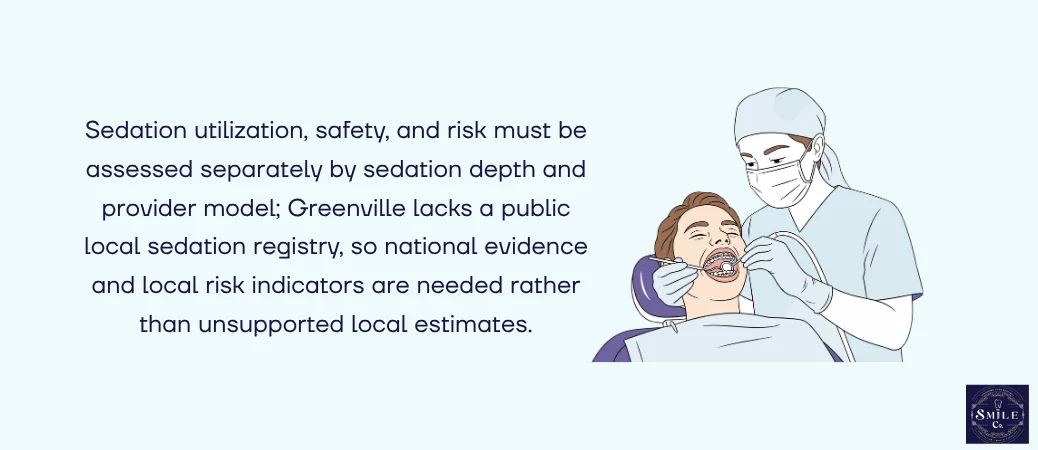
Neither AAOMS nor the South Carolina Board of Dentistry publishes a Greenville-specific registry of sedation volume, adverse events, or mortality; South Carolina’s public surveillance instead concentrates on workforce ratios, attendance surveys, Medicaid utilization and chronic-disease indicators.
The local section below therefore uses Greenville risk-context data and proposes a dedicated local study rather than presenting unsupported local adverse-event estimates.
U.S. sedation utilization
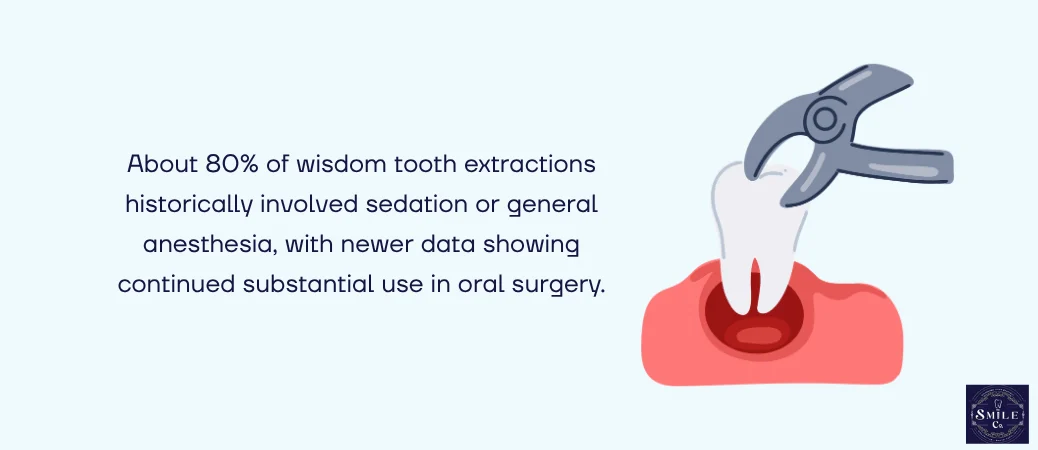
Office-based sedation is standard practice in American oral surgery.
The most complete national breakdown for third-molar (wisdom tooth) extraction, still the dominant oral surgery procedure, with roughly ten million third molars removed from about five million people annually, comes from a survey of U.S. oral surgeons in General Dentistry: general anesthesia in 46.3% of cases, IV conscious sedation in 33.4%, local anesthesia alone in 12.9%, nitrous oxide in 5.8%, and oral sedation in 1.7%.
Roughly 80% of cases therefore involved moderate or deep sedation/GA rather than local anesthesia alone, corroborated by a separate cost-modeling study assuming the same 80% rate.
No equivalent national breakdown has been published for 2019–2026, so this figure should be read as a durable structural pattern rather than a current measurement.
More recent volume data come from AAOMS’s analysis of FAIR Health privately-insured claims: between 2018 and 2021, office-based dental anesthesia reached over 24 million privately insured individuals, including about 8.9 million moderate/deep-sedation/GA cases, 78% performed by OMSs.
Among children needing deep sedation/GA, OMSs provided the service to 80% of 8–12-year-olds and 41% of 1–7-year-olds.
Because these figures exclude Medicaid, uninsured and self-pay patients, they understate total national volume.
Utilization concentrates around specific procedures, including extraction, same-day dental implants, and full-arch restoration, as well as certain patient age groups.
Dental anesthesiology, notably, became the ADA’s tenth recognized specialty in March 2019, formalizing a separate-provider training pathway alongside the OMS team model; on the assisting side, AAOMS recommends, though does not require, that chairside assistants hold its Dental Anesthesia Assistant National Certification (DAANCE).
Regulatory and practice-pattern trends, 2021–2026
The regulatory environment tightened substantially.
The ADA’s Guidelines for the Use of Sedation and General Anesthesia by Dentists were comprehensively revised for the first time in nearly a decade, adopted October 2025, released April 20, 2026, adding BMI to baseline vitals, updating ASA/fasting recommendations, recommending supplemental oxygen for moderate sedation through GA, and requiring documented emergency protocols with regular drills.
Eight organizations, including AAOMS and the ASA, contributed, and the House of Delegates directed development of separate pediatric-specific guidelines.
State-level tightening has been widespread: California’s SB 501 (2022) replaced old permits with Deep Sedation/GA, Moderate Sedation and Pediatric Minimal Sedation categories, adding pediatric endorsements and capnography (SB 1453 added ACLS, effective 2025); Minnesota added capnography and a pediatric endorsement (2023–2024); Texas added periodic jurisprudence exams and facility inspections; Washington and Louisiana updated sedation CE requirements effective 2026. AAOMS’s own Office Anesthesia Evaluation program now requires quarterly mock drills and airway-simulation training, with a 10th-edition manual published December 2025.
The period’s central controversy is the single-operator/operator-anesthetist model itself. In March 2015, six-year-old Caleb Sears died after general anesthesia administered by an Albany, California oral surgeon for removal of a mesiodens; the state dental board later found the surgeon grossly negligent, and the case became the namesake of California’s “Caleb’s Law,” which mandated anesthesia-risk disclosures ahead of the broader SB 501 permit overhaul.
The 2019 AAP/AAPD guideline subsequently recommended a separate anesthesia-trained provider for pediatric deep sedation/GA, and a joint statement from the ASA, Society for Pediatric Anesthesia, and allied groups opposed the single-operator model for children. AAOMS defends team anesthesia as a decades-established, low-risk approach, citing its own case-series data.
This disagreement remains unresolved as of 2026 and will likely shape further state rulemaking.
Adverse-event outcomes and factors associated with risk
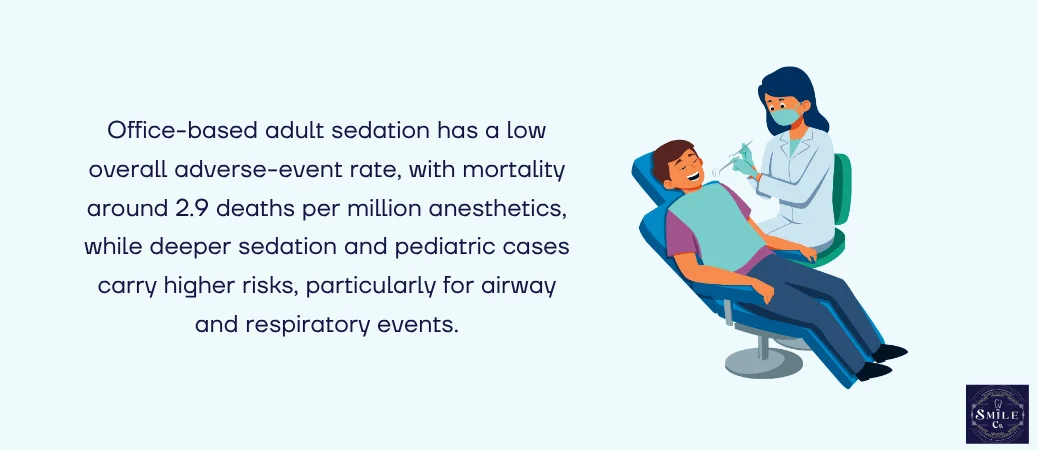
Large retrospective OMS series consistently describe office-based sedation as low-risk in aggregate, though estimates vary by source and become harder to interpret as the outcome gets rarer.
Mayo Clinic’s series of 17,634 team-model sedations (2004–2019) found a 0.1% adverse-event rate and zero deaths. A 2024 review of 61,237 cases from a large private-practice consortium (2010–2022) found roughly 3 adverse events per 100,000 sedations per year, with fentanyl significantly associated with events but no significant association by age, sex, ASA status or procedure type.
A Massachusetts OMS survey of 431,680 visits reported zero deaths. The benchmark U.S. mortality estimate, from OMSNIC closed-claims data covering ~39.4 million office anesthetics over 14 years, found 113 death/brain-injury events, about 1 per 350,000 procedures (≈2.9 per million); an independent 36-year British Columbia study found a closely comparable 2.94 per million.
Airway/respiratory events dominate across these databases, with risk concentrated at age extremes, higher ASA status, and obesity/OSA.
A separate OMS series stratified by depth found roughly 4.8–13.0 events per 1,000 under local anesthesia, 4.0–11.0 per 1,000 under mild-moderate sedation, and 6.9–19.0 per 1,000 under deep sedation/GA, a gradient consistent with deeper sedation carrying proportionally more risk.
Most of this surveillance is voluntary and anonymous, so true rates are likely undercounted.
Pediatric sedation carries a materially different risk profile. Recent studies of moderate sedation in pediatric dentistry report adverse-event rates around 4–5% (a 2025 ten-year study of 923 sedations found 4.55%), higher than adult OMS figures, though mostly minor and rescuable.
Dental-anesthesia deaths have historically concentrated among children aged 2–5 in office settings, often where a general or pediatric dentist rather than a dedicated anesthesia provider administered sedation, the pattern behind the 2019 AAP/AAPD guideline described above.
The resulting risk-management pathway: risk-stratification (ASA status, BMI, airway assessment) → matching depth and provider model to risk → monitoring appropriate to depth (pulse oximetry minimum; capnography for deep sedation/GA) → documented emergency protocols and drills → prompt airway rescue → structured incident reporting.
Greenville and South Carolina local assessment

Greenville County’s characteristics are relevant to sedation risk and access, though none are sedation-specific.
The Greenville Health Authority’s 2024 scorecard reported a dentist-to-population ratio of 1,470:1 (SC 1,680:1; U.S. 1,360:1), 10% adult diabetes, 15% adult smoking, 33% adult obesity, and 15% uninsured adults, all factors independently associated with sedation risk and follow-up access nationally.
South Carolina’s dental-attendance pattern suggests a meaningful access divide relevant to pre-sedation optimization: United For ALICE’s 2024 data found 55% of South Carolina adults below the ALICE financial-hardship threshold had a dental visit within the prior year, versus 73% above it, and 15% below the threshold had not visited in five-plus years (vs. 13% nationally).
Prisma Health’s 2025 CHNA, covering Greenville, identified diabetes as the third-highest community health priority (behind mental health and obesity, relevant given diabetes’ association with sedation risk, and a reason any local study should record glycemic control, not just diagnosis.
Greenville has an active oral surgery market, while sedation services in South Carolina are governed by specific training, permit, monitoring, and facility requirements based on the level of sedation provided.
No permit is required for local anesthesia, nitrous oxide alone, or minimal sedation.
Moderate enteral sedation requires 24 didactic hours and 10 cases; moderate parenteral (IV) sedation requires 60 hours and 20 cases; deep sedation/GA requires an accredited OMS residency (or one year of advanced anesthesia training) plus 60 hours and 20 cases, with an additional 60 pediatric hours and 20 cases to treat children under 13. Current ACLS is required for all permit levels (PALS for pediatric-only practices); deep sedation/GA facilities must maintain a capnograph, advanced airway equipment and ACLS drugs, subject to biennial inspection. Regulation 39-17 requires any licensed dentist to report mortality or serious/unusual incidents to the Board within 30 days. SC LLR provides an online Licensee Lookup and disciplinary search, and since 2019 SC Medicaid has limited sedation reimbursement to permit holders.
The key local gap: none of these sources reveal Greenville’s annual sedation volume, its split by depth, local adverse-event frequency, or whether equipment and drill compliance matches requirements in practice, not just on paper.
Local safety claims should not be extrapolated from practice marketing or national averages alone.
Proposed Greenville study and outlook beyond 2026
A useful local study needs two linked components, since sedation outcomes span both a common, locally measurable tier (moderate/pediatric adverse events) and a genuinely rare tier (mortality) that a single-site or single-year sample cannot estimate.
| Study element | Recommended Greenville design |
| Population | Component A: all SC LLR sedation-permit holders in Greenville County (~13–20+ practices, verified via Licensee Lookup). Component B: all sedation encounters by participating Component A practices |
| Recruitment | Component A: full population audit, not a sample. Component B: voluntary enrollment via SC LLR and the SC Dental Association |
| Sample size | For pediatric/moderate-sedation AEs (benchmark ≈4.5%): ~413 encounters for 95% confidence and ±2pp precision, +20% for attrition ≈ 500 target |
| Rare outcomes | Not estimable cross-sectionally: at a ~0.1% aggregate rate, observing even a few events needs tens of thousands of cases — a multi-year registry-accumulation goal, not a fixed sample; mortality rates should keep relying on national data (DAIRS, OMSNIC) meanwhile |
| Observation | Component A audit 2026–2027, annual re-audit; Component B registry continuous from 2027 to at least 2031 |
| Outcomes | Component A: permit/equipment/staffing compliance. Component B: adverse-event rate by depth and age; time to first occurrence |
| Covariates | ASA status, BMI, age, diabetes control, smoking, procedure type/duration, sedation depth/agents, operator model |
| Analysis | Component A: descriptive compliance rates. Component B: exact/Poisson CIs as volume accumulates; multilevel models for repeated encounters within practice |
Incident classification should use the Board’s own Reg 39-17 definitions and current ASA/ADA terminology, with a contemporaneous standardized case-report form; equipment compliance should be verified by direct inspection rather than self-report.
Beyond 2026, the most defensible forecast is that Greenville-area sedation utilization will track national growth in office-based oral surgery demand, Grand View Research projects the U.S. dental anesthesia market growing from roughly $332.5 million (2023) to about $477 million by 2030, with the global market reaching approximately $2.81 billion by 2030, figures that should be read as directional rather than precise given variation across market-research firms, while the unresolved single-operator debate and the multi-state pattern of permit, equipment and training tightening make further South Carolina regulatory change plausible, though its direction and timing remain unspecified. This is an inference from national trend data, not an observed South Carolina commitment.
Until Greenville-specific registry data exist, national benchmarks should be treated as reference points for the region, not as verified local performance.
References
South Carolina Code of Laws § 40-15-400, “Permits; applications; fees.”
South Carolina Code of Laws § 40-15-410, “Requirements for sedation permit.”
https://law.justia.com/codes/south-carolina/title-40/chapter-15/section-40-15-410/
South Carolina Code of Regulations § 39-17, “Guidelines for Sedation and General Anesthesia.”
Society for Pediatric Anesthesia. “Joint Statement on Pediatric Dental Sedation.”
AAOMS. “Dental Anesthesia Incident Reporting System (DAIRS).”
AAOMS. “Office Anesthesia Evaluation Program.”
Dental Board of California. “SB 501 Notice” and “Alert: SB 1453.”
DOCS Education. “Changes to Dental Sedation Regulations Coming in 2024” (Minnesota).
Greenville Health Authority. “Greenville County Health Rankings Year Comparison, 2021–2024.”
United For ALICE. “ALICE and the Dental Divide: Oral Health in South Carolina” (2024/2025 data).
Greenville Health Authority / Prisma Health. “2025 Community Health Needs Assessment (CHNA) Report.”
SC LLR Board of Dentistry. “Deep Sedation/General Anesthesia Permit Application.”