


Missing teeth can impact more than just your appearance. They affect how you eat, speak, and feel about yourself every day.
When you’re ready to replace missing teeth, dental implants offer a permanent solution that looks and functions like natural teeth.
The choice between single vs multiple dental implants depends on how many teeth you’re missing, where they’re located in your mouth, and your overall oral health goals.
If you have one missing tooth or several non-adjacent gaps, individual implants might be your best option. When you’re missing several teeth next to each other, multiple implants supporting a bridge or other restoration could be more practical.
Understanding the differences between these approaches helps you make the right decision for your situation.
We’ll walk you through how each type works, what to expect during treatment, and how to determine which option will best restore your smile.
Key Takeaways
- Single implants replace individual missing teeth without affecting neighboring teeth, while multiple implants can support bridges or full restorations for several missing teeth
- Your bone density, number of missing teeth, and budget all play important roles in determining which implant approach works best for you
- Both single and multiple dental implants require good oral hygiene and regular dental visits to last for decades
How Dental Implants Work
Dental implants function as artificial tooth roots that fuse with your jawbone through a biological process, creating a stable foundation for replacement teeth.
The implant post, abutment, and crown work together to restore both the appearance and function of your natural teeth.
Implant Components and Materials
A dental implant consists of three main parts that work together to replace your missing tooth. The implant post serves as the artificial root that goes into your jawbone.
The abutment connects the post to the visible part of your tooth. The dental crown sits on top and looks like your natural tooth.
Most implant posts are made from titanium because this material is biocompatible with your body. Your bone accepts the titanium implant post without rejecting it as a foreign object.
Some dentists also use zirconia implants, which are white and metal-free.
The crown is typically made from porcelain or ceramic materials. These materials match the color and shine of your natural teeth. They’re also strong enough to handle normal chewing forces.
The Process of Osseointegration
Osseointegration is the process where your jawbone grows around and bonds with the titanium implant. This biological connection is what makes tooth implants so stable and long-lasting.
The process typically takes three to six months to complete.
During this time, bone cells grow directly onto the surface of the implant post. The bone tissue becomes permanently attached to the titanium surface.
This creates a bond that’s strong enough to support your replacement tooth during eating and speaking.
The success of implant integration depends on several factors. You need adequate bone density and volume in your jaw. Good oral hygiene during healing is essential. Avoiding smoking helps ensure proper healing and fusion.
Role of Abutments and Crowns
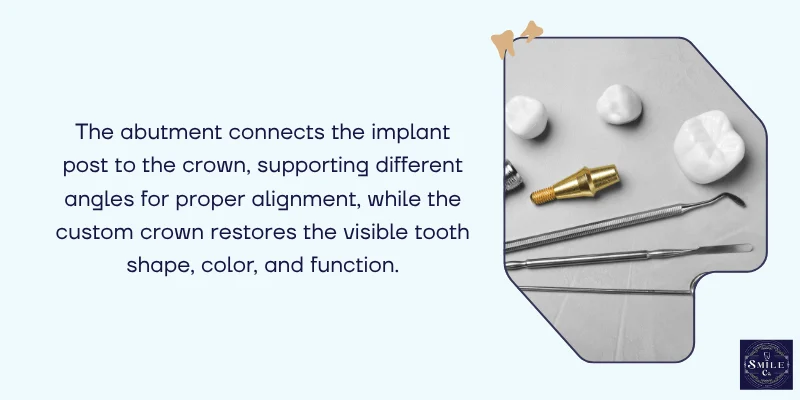
The abutment acts as a connector piece between your implant post and crown. Your dentist attaches it to the top of the implant after osseointegration is complete. It extends slightly above your gum line to hold the crown in place.
Abutments come in different shapes and angles to accommodate various tooth positions. Some are straight while others are angled to match your natural tooth alignment.
Your dentist chooses the right abutment based on where your implant is located.
The dental crown is the visible part that replaces your tooth structure. It’s custom-made to match the size, shape, and color of your surrounding teeth. The crown attaches to the abutment using dental cement or a small screw, creating a complete replacement tooth that functions like your natural teeth.
Single Tooth Implant: Procedure, Indications, and Benefits
A single tooth implant replaces one missing tooth with a titanium post, abutment, and custom crown.
This approach preserves bone, protects neighboring teeth, and restores chewing function with results that can last decades when properly maintained.
When to Choose a Single Tooth Implant
You’re a good candidate for a single tooth implant when you’ve lost one tooth due to decay, injury, or gum disease and want to replace it without affecting the teeth next to it.
Unlike a traditional bridge that requires grinding down healthy adjacent teeth, a single-tooth implant stands alone and doesn’t rely on neighboring teeth for support.
Your implant dentist will check if you have enough jawbone to support the implant. If you’ve been missing a tooth for a while, you might need bone grafting to rebuild the area before placing the implant.
Single tooth implants work well when you want a permanent solution that looks and feels natural. They’re ideal if you want to preserve bone and prevent further tooth loss in the future.
Steps in the Single Tooth Implant Procedure
The tooth implant procedure starts when your dentist places a small titanium screw into your jawbone during oral surgery. This metal post acts as an artificial tooth root.
You’ll then wait two to six months while the implant bonds with your bone in a process called osseointegration.
During this healing time, you can wear a temporary tooth replacement so you won’t have a visible gap. Some implant systems require a second minor procedure to attach a healing cap, though one-stage systems skip this step.
After your gums heal, your dentist attaches a small connector called an abutment to the implant. Finally, they place a custom-made crown on top that matches your natural teeth in color and shape.
The entire process typically takes three to nine months from start to finish, depending on your individual healing and whether you needed any additional procedures.
Benefits for Oral Health and Jawbone
Single tooth dental implants help preserve bone in your jaw because the titanium post stimulates the bone just like a natural tooth root would. Without this stimulation, the bone in the gap starts to deteriorate and shrink over time. This bone loss can change the shape of your face and make you look older.
A single dental implant also prevents your other teeth from shifting into the empty space. When teeth move out of position, it creates bite problems and makes cleaning harder, which can lead to more decay and gum disease.
Your chewing function improves significantly with an implant compared to leaving a gap or using a removable partial denture. You can eat all your favorite foods without worry.
The implant also protects the teeth on either side because it doesn’t require any grinding or alteration of healthy tooth structure.
Longevity and Maintenance
How long do dental implants last? With proper care, single tooth implants can last 25 years or even a lifetime. The titanium implant itself rarely fails once it’s integrated with your bone.
The crown on top typically lasts 10 to 15 years before it might need replacement due to normal wear.
Taking care of your implant is simple:
- Brush twice daily with a soft-bristled toothbrush
- Floss around the implant every day
- Visit your dentist for regular checkups and cleanings
- Avoid chewing on hard objects like ice or pens
You don’t need special cleaning tools or complicated routines. Your implant won’t get cavities, but you still need to prevent gum disease around it.
If you grind your teeth at night, wearing a nightguard protects both your implant crown and natural teeth from excessive force.
Multiple Implants and Implant-Supported Restorations
When you’re missing several teeth, multiple dental implants offer solutions that go beyond replacing each tooth individually. These options can save you money and surgical time while giving you back full mouth function.
When Are Multiple Implants Recommended?
Your dentist typically suggests multiple implants when you’re missing three or more teeth. This approach makes healing easier because only a couple of implants need to be installed to support a bridge of three or more dental crowns.
Multiple tooth implants work well when you have several missing teeth in the same area of your mouth.
The number of implants you need depends on your bone quality, the spacing of your missing teeth, and the type of restoration they’ll support.
If you’ve lost most or all of your teeth in one arch, you’re likely a candidate for full-arch restorations. Your dentist will evaluate your jawbone health and overall oral condition to determine the best approach for your situation.
Implant-Supported Bridges and Their Advantages
An implant-supported bridge uses two or more implants to hold several replacement teeth in place. This option uses fewer implants than individual replacements for each missing tooth, reducing both surgical time and overall expense.
Unlike traditional bridges that rely on grinding down healthy teeth, implant-supported bridges stand independently. You don’t sacrifice any of your natural teeth to support the restoration.
These bridges provide excellent stability for chewing and speaking. They also help maintain your jawbone health by distributing chewing forces across multiple implant points.
Caring for an implant-supported bridge requires special attention between the prosthetic teeth. You’ll need interdental brushes or water flossers to keep the area clean and healthy.
Full-Arch Solutions: All-on-4, All-on-6, and More
Full-arch solutions like All-on-4 or All-on-6 use just four to six strategically placed implants to support an entire arch of replacement teeth. This approach is the most economical option when you’re facing extensive tooth loss.
Key benefits of full-arch restorations:
- Fewer implants needed compared to individual replacements
- Often allows for temporary teeth on the same day as surgery
- Provides immediate function and appearance
- Less invasive than placing many individual implants
The All-on-4 system uses four implants positioned at specific angles to maximize bone contact. All-on-6 adds two more implants for extra support and stability.
These full-arch solutions work even if you have some bone loss. The angled placement of the implants lets your dentist avoid areas where bone is thinner.
Restoring Chewing Ability and Confidence

Multiple teeth implants give you back the ability to eat the foods you love. You can bite into apples, chew steak, and enjoy crunchy vegetables without worry.
Your chewing ability affects more than just food choices. It impacts your nutrition, digestion, and overall health. Full-arch restorations restore nearly all of your natural biting force.
The stability of implant-supported dentures means you won’t deal with slipping or clicking when you talk or eat. You can speak clearly and laugh confidently without fear of embarrassment.
These restorations help maintain your facial structure by preventing the bone loss that happens after tooth loss. This keeps you looking younger and prevents the sunken appearance that comes with missing teeth.
Contact us to get a personalized treatment plan designed around your oral health and budget.
Key Differences and Decision Factors
The choice between single and multiple implants depends on your jawbone condition, budget, and specific dental situation.
Understanding how bone density, costs, and long-term effects differ between these options helps you make the right decision for your oral health.
Bone Density and Jawbone Deterioration
Your jawbone health plays a major role in determining which implant option works best for you. When you lose teeth, jawbone deterioration begins almost immediately as the bone no longer receives stimulation from tooth roots.
Single tooth implants require sufficient bone density at one specific location. If you’ve experienced bone loss, you might need bone grafting before your dentist can place the implant.
Multiple implants need adequate bone support at several locations, which can be more challenging if you’ve had teeth missing for a long time.
Your dentist will likely use a cone beam CT scan to evaluate your bone structure before recommending treatment.
This imaging shows exactly how much bone you have and where additional support might be needed. Computer-guided surgery can help place implants more precisely in areas with limited bone.
The good news is that both single and multiple implants help prevent further jawbone deterioration once placed. They work like natural tooth roots to keep your bone healthy and strong.
Cost and Procedure Complexity
Multiple teeth implants often cost less per tooth than placing individual implants for each missing tooth. Instead of requiring one implant for every tooth, you can use fewer implants to support a bridge that replaces several teeth at once.
Cost Comparison:
- Single tooth implant: One post, one crown, one surgical site
- Multiple teeth implants: Fewer posts supporting multiple crowns via a bridge
The procedure for single implants is generally simpler and involves one surgical site. Multiple implants require more planning and coordination but typically need fewer total surgical appointments than if you replaced each tooth individually.
Your dental insurance coverage and budget will influence which option makes sense for you.
During your implant consultation, ask for a detailed breakdown of costs including any necessary bone grafting, the surgical procedure, and the final restoration.
The dental implant procedure pain is typically manageable with local anesthesia and pain medication for both options.
Suitability for Various Dental Needs
Single tooth implants work best when you’re missing one tooth and want to preserve the integrity of your surrounding teeth. They don’t require any alteration to adjacent teeth, unlike traditional bridges.
You should consider multiple implants when you’re missing several teeth in a row. This approach is more natural-looking and functional than removable partial dentures.
Single implants are ideal for:
- Replacing one missing tooth
- Preserving adjacent healthy teeth
- Maintaining natural spacing
Multiple implants work better for:
- Several missing teeth in sequence
- Full mouth rehabilitation
- Avoiding removable dentures
Your overall oral health also matters. If you have gum disease or other dental issues, these need treatment before either type of implant procedure.
Impact on Jawbone and Facial Structure
Both implant types help maintain your facial structure by preventing bone loss. When teeth are missing, your jawbone shrinks over time, which can make your face look older and sunken.
Single implants preserve bone at one specific location. They maintain the natural contour of your gum line and prevent the collapse that can happen with missing teeth.
Your chewing function stays normal because the implant acts just like a natural tooth root.
Multiple implants provide broader support across a larger area of your jaw. This wider distribution helps maintain facial structure more effectively when you’re missing several teeth.
The implants work together to support your chewing function and keep your bite aligned properly.
From a cosmetic dentistry perspective, both options restore your smile’s appearance. Single implants are custom-made to match your natural teeth exactly.
Multiple implant-supported bridges provide a seamless look across several teeth while maintaining proper facial proportions.
Aftercare, Longevity, and Future Considerations
Both single and multiple implants need consistent care to maintain their function and appearance.
The maintenance requirements remain similar regardless of how many implants you have, and with proper attention, your dental restoration can last for decades.
Proper Maintenance and Dental Checkups
Your implants need daily brushing and flossing just like natural teeth. You should brush twice a day with a soft-bristled toothbrush and clean around the implant crowns carefully.
Flossing becomes especially important around implant restorations. Food particles and bacteria can accumulate near the gum line, which may lead to inflammation or infection if left untreated.
Professional dental checkups should occur every six months. During these visits, your dentist will:
- Check the stability of your implants
- Clean areas you can’t reach at home
- Take X-rays to monitor bone levels
- Examine the gum tissue around each implant
- Adjust your restoration if needed
Regular visits help catch potential problems early. Your dentist can identify issues with your dental implant procedure results before they become serious.
Longevity of Implants Compared to Other Restorations
Research shows that the success and survival rates of implants supporting single-unit and multiunit prostheses are not significantly different in both short and long-term outcomes.
This means whether you choose one implant or several, you can expect similar durability.
Implants typically outlast traditional options. A dental bridge usually lasts 10-15 years before needing replacement. Implants can function for 25 years or longer with proper care.
The implant post itself, which fuses to your jawbone during the dental implant process, can last a lifetime. The crown on top may need replacement after 15-20 years due to normal wear.
Multiple tooth implants spread chewing forces across several points, which can reduce stress on individual components. Single implants bear the full force on one restoration.
Tips for Long-Term Oral Health
Avoid chewing extremely hard foods like ice or hard candy on your implant restoration. These can crack the crown or damage the connection between components.
Quit smoking if you currently use tobacco products. Smoking reduces blood flow to your gums and significantly increases the risk of implant failure over time.
Wear a nightguard if you grind your teeth while sleeping. Grinding puts excessive pressure on your implants and can loosen the restoration or damage the crown.
Stay hydrated throughout the day. A dry mouth allows more bacteria to accumulate around your implants and natural teeth.
Address any signs of problems immediately, including:
- Bleeding or swollen gums around implants
- Loose crowns or bridges
- Pain or discomfort when chewing
- Changes in how your bite feels
Contact your dentist right away if you notice these symptoms rather than waiting for your next scheduled appointment.
Frequently Asked Questions
The number of implants you need depends on how many teeth are missing and where they’re located in your mouth.
Multiple implants can sometimes support more teeth than the number of posts placed, which affects both treatment approach and total cost.
How do I decide whether I need one implant or multiple implants for missing teeth?
The main factor is how many teeth you’re missing and whether they’re next to each other. If you’ve lost one tooth, you’ll need a single tooth implant to replace it.
When you’re missing several teeth in different areas of your mouth, you’ll likely need individual implants for each gap.
If you’re missing three or four teeth that are right next to each other, you might be able to use two implants with a bridge between them instead of placing an implant for every single tooth.
Your jawbone density also plays a role in this decision. If you don’t have enough bone in certain areas, you might need bone grafting before implant placement, which can affect your treatment plan.
Can a single dental implant support two teeth, and when is that a good option?
A single implant typically can’t support two teeth on its own. You need at least two implants to support a bridge that replaces multiple teeth.
When you’re missing two or three teeth that are next to each other, two implants can support a bridge with the replacement teeth attached. This approach costs less than placing an individual implant for each missing tooth.
The implants go on either end of the gap, and the bridge spans between them. This works well when the teeth in the middle of the gap are missing but the bone quality is good where the implants will be placed.
What’s the cost difference between replacing one tooth with an implant versus replacing several teeth with implants?
A single tooth implant costs less upfront because you’re only paying for one titanium post, one abutment, and one crown. The total typically ranges from $3,000 to $5,000 per tooth.
If you need to replace three separate teeth in different parts of your mouth, you’d multiply that cost by three. However, if those three teeth are next to each other, an implant-supported bridge using two implants costs less than three individual implants.
Full-arch solutions become more economical when you’re missing most or all of your teeth. Four to six implants can support an entire arch of replacement teeth at a lower per-tooth cost than individual implants.
When would a dental bridge make more sense than getting multiple implants?
A traditional bridge might make sense if you’re missing one or two teeth and the teeth on either side of the gap already have large fillings or crowns.
Since those neighboring teeth already need work, using them to support a bridge doesn’t sacrifice healthy tooth structure.
Bridges also cost less initially than implants and don’t require surgery. The entire process takes just a few weeks instead of several months.
However, bridges don’t prevent bone loss in your jaw like implants do. You can lose up to 25% of bone volume in the first three months after tooth loss, and bridges don’t stop this process.
Bridges also typically last 10 to 15 years before needing replacement, while implants can last a lifetime with proper care.
What’s the difference between getting individual implants and an All-on-4 treatment for several missing teeth?
Individual implants mean placing a separate titanium post for each missing tooth. This approach works well when you’re missing just a few teeth or when the missing teeth aren’t all in the same area.
All-on-4 uses just four strategically placed implants to support an entire arch of replacement teeth. This full-arch solution is designed for people who are missing most or all of their teeth on the top or bottom.
The individual implant approach gives you separate teeth that you can floss between normally. All-on-4 provides a fixed bridge that’s permanently attached to the implants, requiring special cleaning tools.
All-on-4 often allows you to get temporary teeth placed on the same day as your implant surgery. Individual implants typically require waiting several months between implant placement and receiving your final crowns.
How long does the process take for one implant compared with multiple implants?
A single tooth implant takes about three to six months from start to finish. You’ll have one surgery to place the implant, then wait three to four months for it to fuse with your jawbone before the crown is attached.
Multiple implants can often be placed during the same surgical appointment, even if you’re getting several. You still only need one healing period, so the timeline doesn’t multiply by the number of implants.
The main difference is that the surgery itself takes longer when placing multiple implants. You might be in the dental chair for two to three hours instead of one hour.
Recovery time is similar whether you get one implant or several at once. Most patients return to normal activities within a few days of surgery.