

This guide is focused on the United States nationally and Greenville, South Carolina locally, using evidence published mainly in the last five years and a short outlook beyond 2026.
A key methodological point is that the U.S. has usable national evidence on implant prevalence, peri-implant disease, and long-term survival, but public local surveillance for Greenville-specific dental implant complications is very limited.
South Carolina’s public health resources track oral-health access, BRFSS risk factors, oral-health surveillance, and hospital-acquired infections, yet the state resources reviewed do not list a dedicated public registry for outpatient dental implant infections or implant outcome benchmarking.
That means the dental implant complications statistics are strongest when framed as a risk-environment and access-to-maintenance comparison, not as a direct like-for-like registry comparison of implant failure rates.
Nationally, implant use has expanded rapidly. In NHANES-based analysis of U.S. adults aged 50 and older, the prevalence of having at least one dental implant increased from 1.3% in 1999–2004 to 8.4% in 2015–2020, with marked disparities by race, education, and poverty status.
That rising exposure base matters because even if per-implant survival remains high, a larger implanted population produces a larger absolute burden of biological and technical complications.
National complication rates
The broadest recent signal is that dental implants are generally successful but not complication-free.
A 2024 review reported overall dental implant survival rates in the 92.8% to 97.1% range, while a 2024 twenty-year meta-analysis found survival of 92% in prospective cohorts before addressing loss to follow-up, 78% after conservative imputation, and 88% in retrospective cohorts, concluding that long-term survival is strong but that attrition can make outcomes look better than they really are.
In other words, short- and medium-term performance is usually excellent, while very long-term success depends heavily on maintenance, case mix, and study quality.
For biological complications, recent estimates are consistent enough to be useful for research framing. A 2022 meta-analysis found mean peri-implantitis prevalence of 19.53% at patient level and 12.53% at implant level.
The 2025 AO/AAP systematic review and meta-analysis refined the time dimension: after 5–10 years of loading, peri-implant mucositis prevalence was 47% and peri-implantitis prevalence 22%; within 5 years, incidence was about 12% for peri-implantitis at patient level, rising to 14% within 10 years and 22% within 20 years.
This is the clearest recent evidence that the most common “complication” problem in implant dentistry is not acute surgical failure but chronic inflammatory disease around functioning implants.
Risk is not randomly distributed. Recent evidence repeatedly identifies history of periodontitis, smoking, inadequate plaque control, lack of regular maintenance care, implant position/length, and poorly controlled diabetes as important predictors or correlates of complications.
A 2025 review of prediction models found that peri-implantitis was the most commonly modelled outcome, and the predictors used most often included implant position, implant length, patient age, and prior periodontitis.
A 2024 clinical review likewise notes higher peri-implantitis rates in smokers and in implants that have been in function for at least five years.
Infection trends
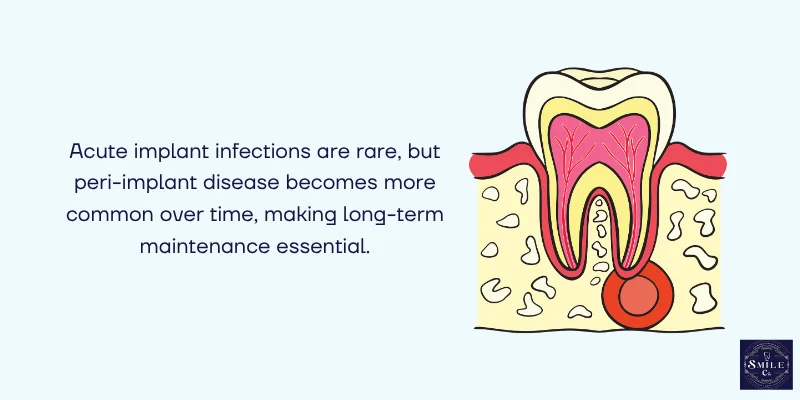
For research purposes, “infection trends” in dental implants are best divided into acute post-operative infection and longer-term peri-implant infection/inflammation.
The recent literature suggests that acute post-operative infection after routine implant placement is relatively uncommon and not the main driver of adverse outcomes.
A 2024 review of prophylactic antibiotics reported that, across seven randomised trials, none individually showed a statistically significant difference in early implant failure or post-operative infection, and a 2022 meta-analysis concluded that antibiotics were likely only of small benefit and should be avoided in most routine cases.
That does not mean infection is irrelevant; it means the bigger epidemiological issue is what happens months and years later, not within the immediate surgical window.
The longer-term trend is clearer: peri-implant disease becomes more common with time in function.
A 2024 review reports that peri-implantitis is most likely after five years of function, with implant-level prevalence rising beyond ten years, and that smokers and patients with prior periodontal disease carry higher burdens.
The AO/AAP consensus also states that the exponential increase in dental implant use has been accompanied by a parallel rise in peri-implant diseases.
This matters because the U.S. is not facing a simple “more implants, same risk” scenario; it is facing “more implants, more ageing patients, and therefore more absolute peri-implant disease burden.”
Microbiologically, peri-implantitis is not just ordinary periodontitis on titanium.
Recent reviews describe a peri-implant environment enriched with Gram-negative anaerobes and opportunistic pathogens, with different tissue vascularity and attachment anatomy than natural teeth.
That anatomical difference helps explain why plaque-related inflammation can progress rapidly once maintenance fails.
For a research guide, the practical implication is that “infection trend” should be operationalised primarily as peri-implant mucositis-to-peri-implantitis progression over time, stratified by host risk and maintenance adherence.
Post-surgical outcomes
When post-surgical outcomes are defined as survival, osseointegration, marginal bone stability, and need for retreatment, the U.S.-relevant evidence remains favourable overall.
Recent reviews still support dental implants as a predictable full-mouth rehabilitation option, but outcomes depend on patient selection and follow-up.
In poorly controlled systemic disease, outcomes worsen; in well-controlled disease, they can approach those of healthier populations.
For example, a 2024 systematic review on type 2 diabetes found implant survival of 96.1% to 97.3% at one year and 87.3% to 96.1% at five years when diabetes was well managed, whereas worse glycaemic control was associated with less favourable peri-implant health and bone metrics.
Marginal bone loss is an especially useful post-surgical outcome for research because it often bridges “survival” and “true success”.
The 2025 AO/AAP review found that marginal bone loss is one of the most commonly studied adverse outcomes, but it also showed that current prediction models are methodologically inconsistent and only rarely externally validated.
That means researchers should avoid over-relying on single-centre risk calculators and instead report bone-loss outcomes with standardised definitions and follow-up windows.
Technical and prosthetic outcomes matter as well, although the literature is more heterogeneous.
Recent scoping work indicates that implant-supported fixed prostheses have high survival but still experience recurrent technical problems over time, while a 2024 review comparing different types of implants, such as full-arch prostheses on four versus six implants found no significant differences in implant or prosthesis survival or in biological/technical complications, though marginal bone loss was somewhat greater in the four-implant group.
This reinforces a broader point: post-surgical success is not simply “implant still present”; it includes restorative dentistry treatments, bone stability, and whether local anatomy or prosthesis design makes hygiene harder.
Greenville and South Carolina local context
Because no public Greenville implant registry was identified, the most defensible local comparison is to examine maintenance access and local risk-factor prevalence.
South Carolina’s adult dental-visit rate in 2024 was 66.0%, slightly below the U.S. rate of 67.5%.
Among lower-income South Carolinians below the ALICE threshold, only 55% reported a dental visit in the prior year, compared with 73% above the threshold, and 15% had not visited a dentist in five or more years, worse than the national average of 13%.
That matters because implant outcomes are highly maintenance-sensitive: lower routine attendance increases the probability that mucositis or early bone loss is detected late.
Greenville County’s public health profile suggests a non-trivial local burden of risk factors linked to peri-implant disease.
The Greenville County year-comparison report shows adult smoking in the mid-teens and diabetes around one in ten adults, with dentist supply fluctuating roughly in the 1,470:1 to 1,770:1 range across recent County Health Rankings reports.
Those figures do not prove worse implant outcomes in Greenville, but they indicate that the local environment contains the same major host and access factors that U.S. implant literature consistently ties to peri-implantitis and poorer long-term maintenance.
The most important research conclusion, therefore, is not that Greenville is demonstrably better or worse than the U.S. on measured implant failure rates; it is that publicly available local data are not granular enough to answer that directly.
South Carolina public health systems track oral-health data and hospital-acquired infections, but the reviewed resources do not provide a public county-level series for outpatient implant failures, peri-implantitis case rates, or implant revision volume.
Any rigorous Greenville-specific study will probably require chart review, claims data, or a practice-based registry, rather than relying on existing public health dashboards alone.
Outlook beyond 2026

Beyond 2026, the strongest forecast is a rising absolute burden of implant complications, even if per-implant success remains high. U.S. implant prevalence in adults over 50 has already risen more than six-fold over two decades, and Census data show that the population aged 65 and older continues to expand, with all baby boomers aged 65 or older by 2030 and roughly one in five Americans projected to be of retirement age by then.
The Census Bureau also reported 61.2 million Americans aged 65 and older in 2024.
Taken together with the AO/AAP consensus that peri-implant disease rises alongside implant utilisation, the likely post-2026 scenario is more implants in older adults, more years of functional loading, and therefore more peri-implant maintenance needs and inflammatory complications.
This is an inference from converging demographic and clinical evidence, not a single direct forecast model.
For a research project, the most useful hypothesis set is therefore: implant survival will remain high nationally; peri-implant mucositis and peri-implantitis will account for a growing share of adverse outcomes; and local differences will be driven less by implant hardware than by maintenance access, smoking, diabetes, periodontal history, and equity in follow-up care.
The main evidence gap is not another broad survival estimate; it is standardised local outcome tracking.
Recent modelling literature confirms that current prediction tools still have limited external validation, so the most valuable “local” next step for Greenville would be a registry-style design that records baseline risk, maintenance attendance, radiographic bone levels, peri-implant probing, and retreatment events over time.
References
[1] [2] [15] Implant and implant restoration trends among adults 50 years and older in the United States, National Health and Nutrition Examination Survey 1999-2020 – ScienceDirect
[3] [7] [8] Peri-Implantitis – PMC
[4] What is the prevalence of peri-implantitis? A systematic review and meta-analysis | BMC Oral Health | Springer Nature Link
[5] [10] [16] Prediction models for the complication incidence and survival rate of dental implants-a systematic review and critical appraisal – PubMed
[6] Is routine antibiotic prophylaxis warranted in dental implant …
[9] Success Rates of Dental Implants in Patients With Diabetes: A Systematic Review – PubMed
[11] Prosthetic complications and failures of implant-supported …
[12] Explore Dental Visit in South Carolina | AHR
[13] Greenville-County-Health-Rankings- …
[14] Data and Reports – Oral Health in SC | South Carolina Department of Public Health