


Feeling nervous about a dental appointment is common, and choosing between sedation options can feel like just one more decision to worry about.
If dental fear has kept you from scheduling care, you are far from alone, and you have real choices for how to get through treatment comfortably.
IV sedation vs. oral sedation comes down to how deep and how fast you need the calm to set in, and how much control your dental team needs over that level during your procedure.
Oral sedation is a pill taken before your visit, working gradually and suited to mild to moderate nerves. IV sedation goes in through a vein, works within minutes, and can be adjusted throughout treatment, which makes it a common fit for severe anxiety or longer, more involved procedures.
Neither option is automatically the better choice. The right fit depends on your anxiety level, your medical history, and what your treatment actually involves.
A sedation dentist can walk through those factors with you before you commit to either path.
Key Takeaways
- Oral sedation works well for mild to moderate anxiety and shorter, routine procedures, while IV sedation offers deeper, adjustable relaxation for severe fear or longer treatment.
- Your medical history, including conditions like sleep apnea, plays a direct role in which sedation method is safe for you.
- Cost, monitoring needs, and recovery time differ between the two, so a consultation before treatment helps you plan ahead.
Table of Content
- How IV and Oral Sedation Work
- Matching Sedation to Your Anxiety and Procedure
- Safety, Monitoring, and Recovery Expectations
- How Much Does Dental Sedation Cost?
- Finding the Sedation Approach That Helps You Get Care
- Frequently Asked Questions
How IV and Oral Sedation Work
Oral sedation and IV sedation both calm your nervous system, but they get there differently.
One works through a pill you swallow before your appointment, and the other works through a line placed in your vein, and that difference in delivery changes how quickly you feel calm and how much your dental team can adjust things once treatment starts.
What Happens With Oral Conscious Sedation?
Oral conscious sedation starts with a pill, usually a benzodiazepine like Valium (diazepam) or Halcion (triazolam), taken about an hour before your appointment. By the time you arrive, you likely already feel drowsy and less aware of your surroundings.
You stay awake and can respond to your dental team, but many patients describe feeling far less bothered by the sounds and sensations of treatment.
The sedative medication works on your central nervous system to slow down the anxious signals that make dental visits feel unbearable.
What Happens With IV Sedation?
IV sedation delivers a sedative like midazolam directly into your bloodstream through an IV line, so it takes effect within a minute or two.
Because the medication goes straight into your vein instead of through your digestive system, your dental team can raise or lower the dose in real time based on how you respond.
That kind of control matters most during longer or more involved procedures, where your comfort needs might shift partway through.
You stay in a state often called “twilight sleep,” relaxed and drowsy but still able to breathe on your own and respond to prompts.
Sedation Levels: Minimal, Moderate, Deep, and General Anesthesia
Dental sedation falls into four recognized levels, and knowing where you land helps set realistic expectations. Minimal sedation leaves you relaxed but fully alert.
Moderate sedation (sometimes called conscious sedation) leaves you drowsy but able to respond to verbal cues. Deep sedation means you are on the edge of consciousness and may not respond easily.
General anesthesia puts you fully unconscious and unable to respond at all.
Most oral and IV sedation used in general dentistry falls into the minimal-to-moderate range.
Deep sedation and general anesthesia are reserved for specific surgical cases and require additional training and equipment to administer safely.
Why Local Anesthesia Is Still Needed
Sedation calms your mind and body, but it does not numb the specific area being treated.
Local anesthesia still gets injected at the treatment site so you do not feel pain during drilling, extractions, or other work, even while you are deeply relaxed from oral or IV sedation.
This combination, sedation for calm plus local anesthesia for numbness, is standard practice and one reason sedation dentistry can feel so different from a typical, tense dental visit.

Matching Sedation to Your Anxiety and Procedure
The right sedation choice depends on two things working together: how intense your dental anxiety feels, and how long or complex your procedure will be.
A quick filling for someone with mild nerves calls for a very different plan than multiple extractions for someone with a dental phobia.
When Oral Sedation May Be Enough
Oral sedation often works well for mild to moderate dental anxiety paired with routine dental work.
Fillings, cleanings, and shorter procedures give the medication enough time to keep you comfortable without needing constant dose adjustments.
If you feel nervous but can generally tolerate a dental chair with some extra support, oral sedation may cover what you need without an IV line at all.
When IV Sedation May Be a Better Fit
IV sedation tends to suit severe dental anxiety or dental phobia, especially when a procedure runs long or involves multiple steps.
Because the dose can be adjusted mid-treatment, your dental team can respond if you need a deeper level of calm partway through.
Patients who have tried oral sedation before and found it did not go far enough often move to IV sedation for future visits.
Procedures That May Call for More Sedation Support
Certain treatments may make IV sedation worth considering because of their length or complexity.
Multiple extractions, wisdom teeth removal, dental implants, and full-mouth reconstruction can fall into this category depending on the patient and treatment plan.
| Factor | Oral Sedation | IV Sedation |
| How it’s given | Pill before your visit | Through an IV line |
| Onset | About 30-60 minutes | Within 1-2 minutes |
| Dose adjustable mid-procedure | No | Yes |
| Best suited for | Mild to moderate anxiety, shorter visits | Severe anxiety, longer or complex procedures |
| Relative cost | Generally lower | Generally higher due to additional monitoring and administration requirements |
Wisdom tooth removal and dental implant placement, in particular, often involve enough time and precision that dentists lean toward IV sedation.
If dental implants are part of your treatment plan, ask about sedation options during your consultation so you know what to expect on procedure day.
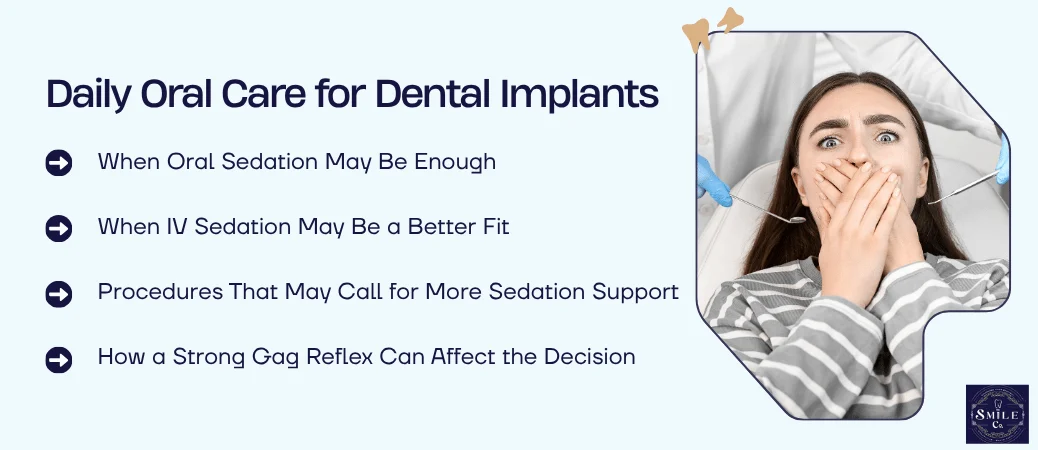
How a Strong Gag Reflex Can Affect the Decision
A strong gag reflex can make even routine dental care difficult. For some patients, sedation can make treatment easier to tolerate by helping them feel more relaxed throughout the appointment.
Whether oral or IV sedation is appropriate depends on the severity of your gag reflex, your anxiety level, your health history, and the procedure being performed.
If gagging has kept you from completing cleanings, X-rays, or other dental treatment in the past, mention it during your consultation so your dental team can factor it into your sedation plan.
Safety, Monitoring, and Recovery Expectations
Sedation dentistry is considered safe when a qualified team reviews your health history and monitors you throughout treatment.
What changes from patient to patient is how much evaluation and monitoring your specific situation calls for.
What Your Medical History Can Change
Your medical history can rule certain sedation methods in or out before you ever sit in the chair.
Conditions like sleep apnea, heart disease, or respiratory issues affect how your body handles sedative medication, and current medications can interact with benzodiazepines like Valium or midazolam.
Be upfront about every medication and condition during your consultation, even ones that feel unrelated to dental care. Your dental team needs the full picture to recommend a safe option.
Who May Need Additional Evaluation Before Sedation?
Patients with sleep apnea, significant heart or lung conditions, or a history of complications with anesthesia may need extra evaluation before sedation, sometimes involving an anesthesiologist.
This does not mean sedation is off the table. It means your team wants more information first.
Older adults and patients on multiple medications often fall into this group as well.
How Sedation Teams Monitor You During Treatment
During IV sedation, your dental team watches your vital signs continuously using tools like pulse oximetry (which tracks oxygen levels in your blood) and capnography (which tracks your breathing).
This continuous monitoring lets the team catch changes early and adjust your care right away.
Oral sedation involves monitoring too, though typically at a lighter level since the dose cannot be adjusted mid-procedure the way IV medication can.
Will You Remember the Appointment and When Can You Drive?
Both oral and IV sedation carry an amnesic effect, meaning many patients remember very little about the appointment afterward even though they were technically awake.
This memory loss is common but not something your dental team can promise you.
You will need someone to drive you home after either type of sedation, since the drowsiness lingers for hours.
Plan for a full day of rest afterward, and avoid important decisions or tasks until the sedative fully clears your system.
How Much Does Dental Sedation Cost?
The cost of dental sedation depends on the type of sedation, the length and complexity of your procedure, and the level of monitoring required.
Oral sedation is generally less expensive than IV sedation because it involves a simpler medication and administration process.
Why IV Sedation Usually Costs More Than Oral Sedation
IV sedation typically requires additional monitoring, equipment, and clinical oversight throughout treatment. The length of your procedure can also affect the overall cost.
Ask your provider for an estimate based on your treatment plan so you understand what is included before scheduling.
What Should You Ask About Sedation Costs?
Before choosing a sedation option, ask what is included in your treatment estimate and whether there are separate fees related to sedation, monitoring, or the length of the procedure.
If you plan to use dental benefits, confirm your specific coverage directly before treatment. Your dental team can also explain available payment options and help you understand the expected cost of your care.
Questions to Ask Before Accepting a Sedation Estimate
Ask your provider whether the quoted price includes the full procedure time or whether additional fees may apply based on treatment length.
You can also ask what monitoring or sedation-related services are included so you have a clear understanding of the expected cost before treatment.
Finding the Sedation Approach That Helps You Get Care

Sedation dentistry exists to help you get treatment done, not to add another layer of stress to the decision.
Whether oral sedation or IV sedation fits you better comes down to your anxiety level, your health history, and what your specific procedure requires, and a sedation dentist can walk through all of it with you before anything is scheduled.
At The Smile Company, the team reviews your medical history, current medications, and treatment plan together so the sedation choice fits your actual needs, not a one-size-fits-all default.
If dental anxiety has kept you away from care, a conversation about sedation dentistry options is a reasonable first step, without any pressure to commit to a specific method before you feel ready.
Frequently Asked Questions
Is IV sedation stronger than oral sedation?
IV sedation typically produces a deeper, more adjustable level of relaxation because the medication enters your bloodstream directly instead of passing through digestion.
That said, “stronger” depends on dosage and your individual response, and your dental team calibrates either method to your specific needs rather than applying a fixed strength.
Do you feel pain with oral sedation?
Oral sedation calms your mind and body, but local anesthesia still numbs the treatment area, so you should not feel pain during the procedure itself.
You may feel pressure or vibration, but the sharp discomfort that fuels dental fear is managed separately through numbing.
Who is not a good candidate for IV sedation?
Patients with certain heart conditions, uncontrolled respiratory issues, or complications with past anesthesia may need additional evaluation before IV sedation is approved.
Your dentist reviews your full medical history, including conditions like sleep apnea, to determine whether IV sedation is safe for you or whether another option fits better.
Is IV sedation the same as general anesthesia?
IV sedation is not the same as general anesthesia. IV sedation typically keeps you in a moderate, responsive state where you can answer questions and breathe on your own, while general anesthesia makes you fully unconscious and requires a different level of monitoring and provider training.
Is IV sedation better for wisdom teeth removal?
IV sedation is often recommended for wisdom teeth removal, especially when the teeth are impacted or multiple extractions are needed in one visit.
The adjustable dosing and faster onset help your provider manage a longer, more involved surgical procedure.
What is the safest form of dental sedation?
No single sedation method is universally the safest, since safety depends on your health history, the procedure, and how closely you are monitored during treatment.
A qualified dental team reviewing your medical history beforehand and using continuous monitoring during sedation is what makes any method, oral or IV, as safe as possible for you specifically.