


You’ve probably heard a lot of conflicting information about dental implants and insurance coverage. Some people say insurance never covers them, while others claim you can get full coverage if you know the right tricks.
These common myths about dental implants can make it hard to figure out what’s actually true when you’re trying to plan for this important dental procedure.
Most dental insurance plans don’t cover implants because they’re often classified as cosmetic procedures, but some plans may offer partial coverage when implants are medically necessary to restore function.
Understanding what your specific insurance plan covers can save you from unexpected bills and help you make better decisions about your dental care.
The truth is that navigating dental implant insurance coverage doesn’t have to be confusing once you separate fact from fiction.
By learning what really affects your coverage and exploring all your options, you can approach this investment with confidence and clarity.
Key Takeaways
- Many insurance plans treat dental implants as cosmetic rather than necessary, which limits coverage options
- Some plans may partially cover implants when they’re needed to replace teeth lost due to injury or decay
- Alternative financing options like payment plans and health savings accounts can help make implants more affordable
Common Insurance Myths Surrounding Dental Implants
Many people believe false information about how dental insurance handles implant procedures.
Insurance companies often have specific rules about what they cover, and understanding the real facts can help you plan better for treatment costs.
All Dental Insurance Covers Implants
Not every dental insurance plan includes coverage for implants. Many basic plans focus on preventive care like cleanings and fillings but leave out major procedures.
Your specific plan determines what you can claim. Some employers offer premium dental insurance plans that include partial implant coverage, while others only cover traditional options like bridges or dentures.
You need to read your policy documents carefully to see what’s included.
Most insurance companies view implants differently than standard dental work. They may cover some parts of the procedure but not others.
Before you assume your plan includes dental implant coverage, contact your insurance provider directly and ask specific questions about implant benefits.
Implants Are Always Classified as Cosmetic Procedures
Insurance companies don’t always label implants as cosmetic treatments. The classification depends on why you need the implant and what your specific policy says.
When an implant replaces a tooth lost due to injury, disease, or decay, many insurers consider it medically necessary rather than cosmetic.
This distinction matters because insurance coverage for dental implants often depends on whether the procedure restores function or just improves appearance.
Your dentist can help document medical necessity in your case. If losing a tooth affects your ability to chew food properly or causes jaw problems, this strengthens your claim for coverage.
Some plans still won’t cover implants regardless of medical need, but many modern policies recognize their therapeutic value.
Insurance Covers the Entire Cost of Dental Implants

Even when you have dental insurance for implants, you’ll likely pay some costs yourself. Full coverage for the entire procedure is rare.
Your insurance might cover different parts of the treatment at different rates. Common coverage patterns include:
- Consultation and X-rays: Often 80-100% covered
- Tooth extraction: Usually 50-80% covered
- Implant post placement: Rarely fully covered, sometimes 0%
- Crown attachment: Often 50% covered
Most dental insurance coverage has annual maximums between $1,000 and $2,000. Since implants can cost $3,000 to $6,000 per tooth, you’ll reach this limit quickly. The remaining balance becomes your responsibility.
Some plans classify implant procedures under different benefit categories, which affects how much they pay. Understanding your policy’s fine print helps you budget accurately for out-of-pocket expenses.
Understanding Dental Implants and Their Benefits
Dental implants are artificial tooth roots made of titanium that support replacement teeth and offer a permanent solution for missing teeth.
They preserve jawbone health through osseointegration and provide better stability than traditional dentures or bridges.
What Are Dental Implants?
Dental implants are small titanium posts that your dentist surgically places into your jawbone to replace missing tooth roots. The most common type is endosteal implants, which go directly into your jaw.
The titanium post acts as an artificial root that bonds with your bone through a process called osseointegration. This creates a stable foundation for your replacement tooth.
Each implant has three main parts:
- Implant post: The titanium screw placed in your jawbone
- Abutment: A connector piece attached to the post
- Crown: The visible tooth portion, often made from porcelain
Modern implant dentistry has made these replacement teeth look and function just like natural teeth. You can eat, speak, and smile without worry.
Dental Implant Procedure and Surgery Explained
The dental implant procedure typically happens in stages over several months. Your dentist first evaluates your jawbone density to ensure you have enough bone to support the implant.
During oral surgery, your dentist numbs the area and places the titanium post into your jawbone. Most patients report minimal discomfort during dental implant surgery compared to other dental procedures.
After placement, osseointegration takes 3-6 months as the implant fuses with your bone. Once healed, your dentist attaches the abutment and places your custom crown.
You can usually return to normal activities within a day or two after surgery. The healing process requires good oral hygiene and following your dentist’s care instructions.
Advantages Over Dentures and Dental Bridges
Dental implants offer several advantages compared to traditional tooth replacement options. Unlike dentures, implants don’t slip or click when you talk or eat.
A dental bridge requires grinding down healthy adjacent teeth for support. Implants stand alone without affecting your other teeth.
Key benefits of dental implants include:
- Prevent bone loss in your jaw
- Last 20+ years with proper care
- Feel and function like natural teeth
- Maintain your facial structure
- No special cleaning required beyond regular brushing
Dentures can accelerate jawbone loss since they sit on top of your gums. Implants actually stimulate your jawbone, preserving its density and strength. This helps maintain your natural face shape and prevents the sunken appearance that often comes with tooth loss.
Breaking Down the Cost of Dental Implants
A single dental implant typically costs between $3,000 and $4,500, but this price varies based on your specific needs and location.
Understanding what drives these costs and what additional expenses you might face helps you plan your budget better.
Dental Implant Cost vs. Other Tooth Replacement Options
When you compare tooth replacement options, dental implants often have the highest upfront cost. A dental bridge usually costs between $2,000 and $5,000 for a three-unit bridge.
Dentures range from $1,000 to $3,000 for a full set.
However, implants last much longer than other options. Bridges typically need replacement every 7 to 10 years. Dentures require adjustments and replacements every 5 to 8 years.
When you calculate the lifetime cost, implants often become more affordable. You avoid repeated replacement costs and dental visits.
Implants also protect your jawbone from deteriorating, which prevents future dental problems and expenses.
What Factors Affect the Total Price?
Your total dental implant cost depends on several key factors. The implant post itself costs between $1,000 and $3,000. The abutment that connects to your implant post adds another $500 to $1,500.
A porcelain crown on top typically costs $1,000 to $3,000.
Your location affects pricing significantly. Urban areas usually charge more than rural locations. Your dentist’s experience level also impacts the price.
The condition of your jawbone matters too. If you need bone grafts to support the implant, expect to pay an additional $300 to $3,000. A sinus lift procedure can add $1,500 to $2,500 to your total bill.
Hidden and Additional Costs to Consider
Beyond the basic procedure, you face several additional expenses that many patients don’t expect. Your initial consultation with X-rays costs $100 to $300. Some patients need CT scans, which add another $350 to $515.
Temporary teeth while your implant heals can cost $300 to $3,000. Pain medication and antibiotics after surgery typically run $50 to $200.
You’ll also need follow-up appointments to check healing progress. Most dentists include these visits in the original quote, but some charge separately.
Ask your dentist for a complete breakdown of what your quote includes and what costs extra.
Sedation options beyond local anesthesia cost more. IV sedation adds $500 to $1,000 to your bill.
How Dental Insurance Plans Handle Implant Coverage
Dental insurance plans treat implant coverage differently based on plan type, with most setting strict annual maximums and requiring pre-authorization.
Your out-of-pocket costs can vary significantly depending on whether you choose in-network or out-of-network providers.
Types of Dental Insurance Plans and Coverage Differences
Dental PPO plans typically offer the most flexibility for implant procedures. With a PPO, you can visit any dentist, but you’ll pay less when you stay in-network.
These plans usually categorize implants as major services with 50% coinsurance, meaning you pay half the cost.
HMO dental plans rarely cover implants at all. If they do, you must use network providers and get prior approval.
Traditional indemnity plans give you the most provider choice. However, dental insurance plans commonly cap total benefits between $1,000 and $2,000 per year, which falls far short of implant costs.
Your premium affects your coverage level. Plans with higher monthly premiums often include better implant benefits, while budget plans may exclude them entirely.
Your deductible also matters—you’ll pay this amount before your plan starts covering any services.
Waiting Periods, Annual Maximums, and Pre-Authorization
Most dental plans impose waiting periods before covering major procedures like implants. You might wait 6 to 12 months after enrolling before your plan will pay anything toward implants.
Your annual maximum is the total amount your plan pays each year. Most plans set this between $1,000 and $2,000, but implants can cost $2,600 to $5,400 per tooth. This means you’ll pay most costs yourself even with coverage.
Pre-authorization requirements are standard for implants. Your dentist must submit treatment plans and X-rays to your insurance company for approval before starting work.
The insurer reviews whether the procedure is medically necessary rather than cosmetic.
Some carriers limit implant coverage to one per year, so replacing multiple teeth takes several years under these restrictions.
In-Network vs. Out-of-Network for Implants
Choosing an in-network dentist significantly reduces your costs. In-network providers have negotiated rates with your insurance company, so you’ll pay less per service. Your copay is also lower, and you won’t face balance billing.
Out-of-network dentists can charge whatever they want. Your insurance might cover a portion based on “usual and customary” rates for your area, but you’ll pay the difference. This can add hundreds or thousands to your total bill.
PPO plans give you out-of-network benefits, though at reduced rates. You might get 50% coverage in-network but only 30% out-of-network. HMO plans typically won’t pay anything for out-of-network care except emergencies.
Debunking Myths About Implant Procedure, Recovery, and Suitability
Many worries about dental implant surgery come from outdated information or misunderstandings about how modern implant dentistry works.
The procedure is less painful than most people expect, candidacy depends on your specific oral health, and caring for implants fits into your normal routine.
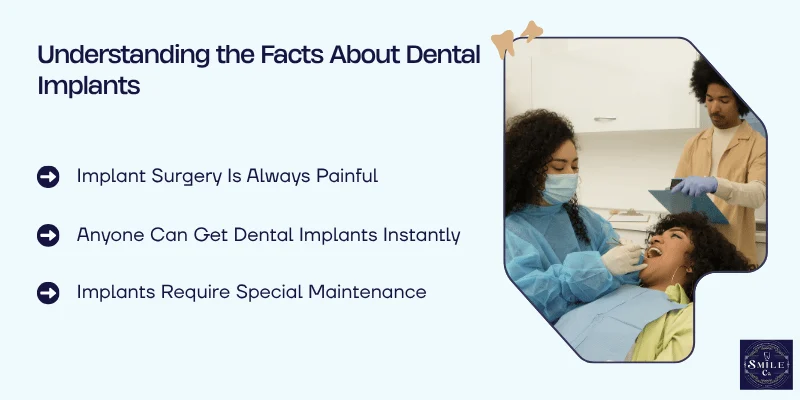
Implant Surgery Is Always Painful
Most people think dental implant surgery will be extremely painful. The reality is quite different.
Modern techniques use local anesthesia, sedation, or general anesthesia to keep you comfortable during the procedure. You won’t feel pain while the dentist places the titanium posts into your jawbone.
After surgery, you might have some soreness or mild swelling. This is normal and manageable with over-the-counter pain medication. Most patients say the procedure is far less painful than they expected.
Recovery time is usually quick. Discomfort typically fades within a few days. You can return to normal activities within a week in most cases.
Anyone Can Get Dental Implants Instantly
Not everyone qualifies for immediate implant placement. Your jawbone density and gum health determine whether you’re a good candidate.
You need adequate jawbone to support the implant. If you have bone loss from missing teeth or gum disease, you may need preparatory treatments first. Bone grafts can rebuild lost jawbone before implant placement.
Conditions like untreated gum disease must be addressed before surgery. Your dentist will check for issues like peri-implantitis risk factors during your consultation.
The evaluation process helps ensure successful long-term results. Some patients receive same-day implants, while others need several months of preparation. Your specific situation determines the timeline.
Implants Require Special Maintenance
You don’t need complicated routines to care for dental implants. They require the same basic care as natural teeth.
Daily care includes:
- Brushing twice daily with a soft-bristled toothbrush
- Flossing around the implant and crown
- Using antimicrobial mouthwash if recommended
Regular dental checkups help prevent problems. Your dentist will monitor your jawbone health and check for early signs of infection. Good oral hygiene prevents peri-implantitis, which is gum inflammation around the implant.
Unlike dentures, implants don’t need adhesives or soaking solutions. You won’t need special cleaning tools beyond what you already use. Implant care fits right into your daily routine without extra steps.
Financing Solutions and Alternatives to Maximize Coverage
You can reduce your dental implant costs significantly through pre-tax accounts, discount plans, and flexible payment options. Many patients combine multiple strategies to make implants affordable even when dental insurance coverage for implants falls short.
Using FSAs, HSAs, and Dental Discount Plans

FSAs and HSAs let you pay for dental implants with pre-tax dollars, which can save you 20-30% depending on your tax bracket.
HSAs offer more flexibility since funds roll over year to year, while FSAs typically require you to use the money within the plan year.
Dental discount plans work differently from private dental insurance. You pay an annual membership fee (usually $100-200) and get 10-60% discounts on procedures at participating dentists.
These plans have no annual maximums or waiting periods.
You can combine these options for maximum savings. For example, you might use a dental discount plan to reduce the overall cost, then pay with HSA funds to get the tax benefit.
Some discount plans like Careington even work alongside your existing insurance.
Popular Financing Options and Payment Strategies
CareCredit is one of the most common financing options for dental implants. It offers 0% interest for 6-24 months if you pay off the balance in time.
Many dental offices also provide in-house payment plans that let you spread costs over 12-24 months.
You can maximize your benefits by splitting procedures across calendar years. If your insurance has a $1,500 annual maximum, schedule the implant placement in December and the crown in January to use two years of benefits.
Getting pre-authorization before treatment helps you understand exactly what your plan will cover. This prevents surprise bills and gives you time to arrange financing for any gaps in coverage.
Frequently Asked Questions
Many people have concerns about dental implants based on things they’ve heard from friends or read online. These questions address common worries about how long implants last, their appearance, pain levels, costs, and care requirements.
Can dental implants really last a lifetime or is that just a myth?
Dental implants can actually last a lifetime when you take proper care of them. The success rate for properly placed implants is about 95 to 98%.
The implant itself rarely needs replacement. However, the crown on top may need to be replaced after 10 to 15 years of normal use.
Your implants need the same care as natural teeth. Regular brushing, flossing, and dental checkups help ensure they stay healthy for decades.
Is it true that dental implants are more costly than other tooth replacement options?
Dental implants do cost more upfront than dentures or bridges. A single implant typically ranges from $3,000 to $6,000.
However, dental implants offer better long-term value compared to other options. Bridges and dentures need frequent replacements over the years.
Many dental offices offer payment plans or EMIs to make the cost more manageable. Whether dental insurance covers implants depends on your specific plan, as coverage varies widely.
I’ve heard dental implants can cause headaches, is that just a rumor?
Dental implants themselves don’t typically cause headaches. This is mostly a rumor without scientific backing.
Any temporary discomfort after the procedure is usually minor. Most patients report feeling less pain from an implant than from a tooth extraction.
If you experience persistent headaches after getting implants, you should contact your dentist. The issue is likely unrelated to the implant itself.
Some say dental implants look fake; are they noticeable compared to natural teeth?
Modern dental implants look completely natural when placed by trained professionals. The porcelain crowns are custom-made to match your natural teeth in color, shape, and size.
You won’t be able to tell the difference between a properly done implant and your real teeth. Other people won’t notice them either.
The technology has advanced significantly in recent years. Implants now blend seamlessly with your smile.
I’ve been told that getting dental implants is a very painful process. Is this the case?
Getting dental implants is not as painful as many people fear. Most patients experience less discomfort from an implant procedure than from a tooth extraction.
Your dentist uses local anesthesia during the procedure so you won’t feel pain. Any discomfort afterward is typically minor and manageable with prescribed medication.
The healing process is generally smooth. Most people return to normal activities within a few days.
Do people often think dental implants require no maintenance?
Some people mistakenly believe implants need zero maintenance because they’re artificial. This isn’t true at all.
Dental implants require the same care as your natural teeth. You need to brush twice daily, floss regularly, and visit your dentist for checkups.
Good oral hygiene helps your implants last longer. Neglecting care can lead to complications around the implant site, just like with natural teeth.