

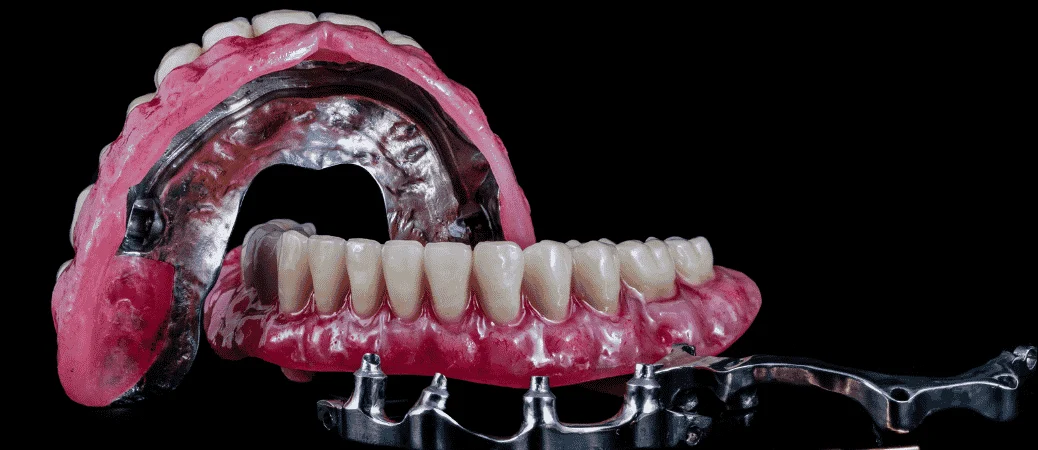
If you have healthy teeth on top but a failing bridge or loose denture on the bottom, or the other way around, all-on-4 for one arch may allow you to restore only the jaw that needs treatment while leaving the opposing arch in place.
The upper jaw (called the maxilla) and lower jaw (the mandible) are different structures with different bone quality, different anatomy to plan around, and different healing patterns.
That means a one-arch decision is a specific clinical judgment based on your scans and bite, not just a way to save money or time upfront.
Choosing to restore one arch now can be the right, medically sound choice when your remaining natural teeth or denture are stable enough to support a healthy bite against new implants.
The rest of this guide explains how dentists make that call, what differs between upper and lower treatment, and what your healing and daily life will look like along the way.
Key Takeaways
- A single-arch All-on-4 can be appropriate when the opposing jaw has healthy teeth, a stable denture, or a sound bridge that supports a balanced bite.
- Upper and lower jaw treatment differ because of bone density, the maxillary sinus, and the nerve that runs through the lower jaw.
- CBCT imaging, your gum health, and conditions like uncontrolled diabetes all shape whether four implants, six implants, or a different plan fits your case.
When Is One-Arch All-on-4 the Right Choice?
One-arch All-on-4 makes sense when only one jaw has failing, missing, or badly worn teeth, and the other jaw is healthy enough to bite against a new fixed arch without strain.
This is a full-arch restoration limited to a single jaw. It replaces every tooth in that arch with fixed teeth attached to four implants, while leaving the opposing arch untouched.
The decision is not about cutting corners. It is about matching treatment to what your mouth actually needs.
What Does a Single-Arch Full-Arch Restoration Replace?
A single-arch restoration replaces all of the missing teeth in one jaw with a fixed bridge that does not come out of your mouth.
Unlike traditional dentures or removable dentures, which you take out at night for cleaning, this bridge stays anchored to four implants and functions much like natural teeth for chewing and speaking.
This differs from replacing individual missing teeth one at a time. Instead of separate implants for each gap, four implants share the workload across the whole arch.
When Can the Opposing Teeth Stay in Place?
The opposing arch can often stay untreated when it has enough natural teeth, or a well-fitting denture or bridge, to hold up its end of your bite.
Dentists look at whether those teeth are stable, free of active decay or gum disease, and capable of handling normal chewing pressure without shifting or wearing down quickly.
If the opposing teeth are loose, badly decayed, or under a poorly fitting removable denture, treating just one arch can create new problems.
The healthy new arch may end up doing more work than the aging one can match.
Why a Balanced Bite Matters Before Treating One Jaw
A balanced bite protects your new implants from taking on too much bite force from an uneven opposing arch.
When one side is fixed and stable, and the other flexes, shifts, or wears unevenly, that mismatch can put extra strain on the new implants over time.
Your dentist checks how your upper and lower teeth meet before finalizing a one-arch plan.
This step gets the same attention as choosing implant positions, because a strong bite on one side does little good if the other side cannot support it.
How Upper and Lower Jaw Treatment Differs
The upper and lower jaws are built differently, and that changes how implants are placed in each one.
Bone density, nearby anatomy, and healing speed all shift between the maxilla and the mandible, which is why a plan that works well on top may need adjusting for the bottom.
Why the Upper Maxilla Often Has Less Dense Bone
The upper jawbone tends to be softer and less dense than the lower jawbone, which affects how firmly implants can be anchored at placement.
Bone density and bone volume in the maxilla are naturally lower because of the bone’s structure and its proximity to the sinus cavities above the back teeth.
This does not rule out upper-arch treatment. It does mean your dentist may angle implants differently or consider more support points to make up for softer bone.
How the Maxillary Sinus Affects Upper Implant Placement
The maxillary sinuses sit directly above your upper back teeth, and implants must avoid them.
The classic All-on-4 design places the back two implants at an angle, roughly 30 to 45 degrees, specifically to reach solid bone in front of the sinus rather than through it.
This angled approach lets many patients avoid a separate sinus lift procedure. Your CBCT scan shows your dentist exactly where your sinuses sit so implants can be placed safely around them.
How the Inferior Alveolar Nerve Shapes Lower Implant Planning
The inferior alveolar nerve runs through the lower jawbone and controls feeling in your lip, chin, and lower teeth.
Implants placed too close to this nerve can cause numbness or tingling, so lower-jaw implant positions are planned carefully to stay in front of it.
Because the lower jaw generally has denser bone and this nerve is the main anatomical limit, lower-arch surgery tends to have a somewhat more predictable healing pattern.
Why Bone Loss Does Not Affect Every Jaw the Same Way
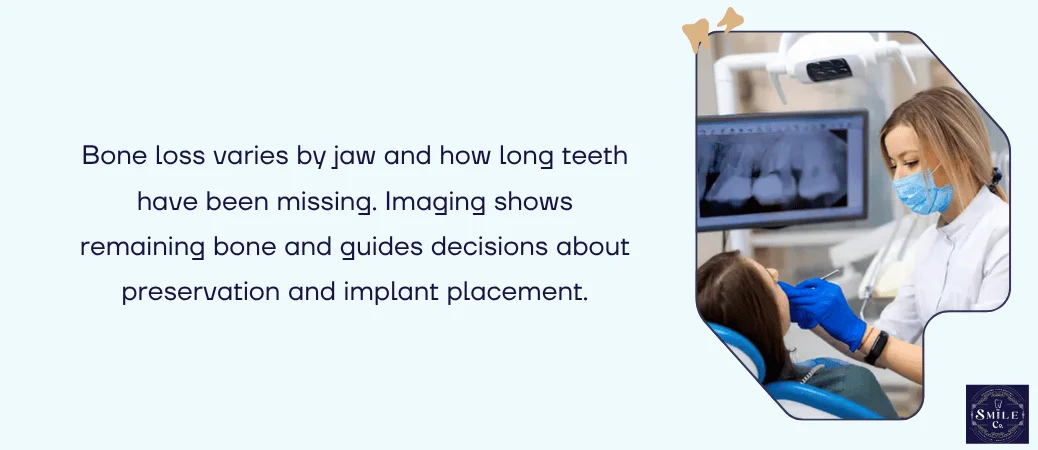
Bone loss, also called bone resorption, happens at different rates and in different patterns depending on which jaw and which teeth were lost first.
Years without teeth can shrink the jawbone in that area, but the upper and lower jaws do not resorb identically.
Your dentist’s imaging shows exactly how much bone remains and where, which guides decisions about bone preservation and implant angle.
This is part of why the same patient might get very different recommendations for their upper arch compared to their lower arch.
How Dentists Decide Whether You Need Four, Six, or Another Option
Dentists rely on 3D imaging, a review of your gum and bone health, and your bite forces to decide between four implants, six implants, or a more involved solution like bone grafting or zygomatic implants.
No two mouths are planned exactly the same way, even when both patients are missing all their teeth in one arch.
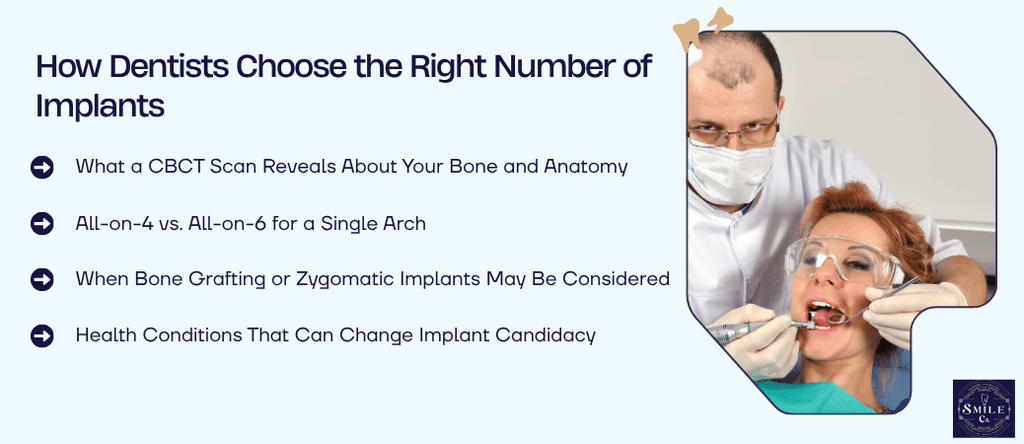
What a CBCT Scan Reveals About Your Bone and Anatomy
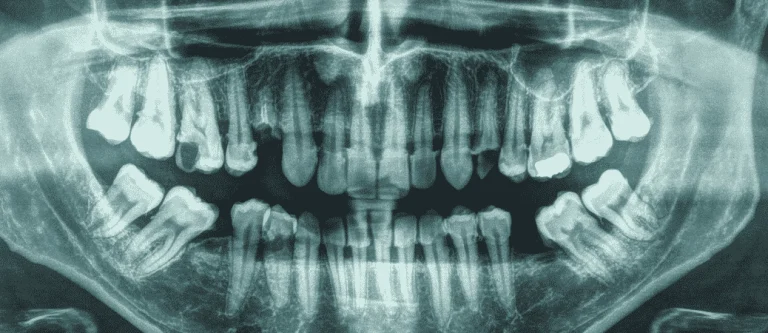
A CBCT scan (a 3D X-ray of your jaw) shows your dentist the exact height, width, and density of your bone, along with the position of your sinuses and nerves.
This imaging step happens before any surgery is planned, and it is what separates a generic treatment estimate from a plan built for your mouth.
Dr. Thorpe A. Jacob uses this scan to evaluate implant position, number, and angle based on your individual anatomy.
This imaging, along with a review of your health history, helps him make important treatment decisions well before surgery day.
All-on-4 vs. All-on-6 for a Single Arch
All-on-6 adds two more implants to the same basic design, spreading bite force across six anchor points instead of four.
This can help when you have a stronger bite, grinding habits, a wider arch, or bone quality that benefits from extra support.
| Factor | All-on-4 | All-on-6 |
| Implants placed | 4 | 6 |
| Best suited for | Standard bone density and bite force | Higher bite force or wider arch |
| Load distribution | Concentrated on 4 points | Spread across 6 points |
| Typical bone requirement | Works well even in atrophic (thinned) bone | Often needs slightly more available bone |
| Relative cost | Lower implant count, generally lower cost | Higher implant count, generally higher cost |
The right choice depends on what your scan and bite assessment show, not a fixed rule for every patient.
When Bone Grafting or Zygomatic Implants May Be Considered
Bone grafting adds material to rebuild areas where bone has thinned too much to hold an implant securely. This step is not automatic.
Many All-on-4 cases avoid grafting entirely because the angled implant design was built to work with limited bone.
In cases with severe upper-jaw bone loss, zygomatic implants anchor into the cheekbone instead of the jawbone, offering another route to fixed teeth when the maxilla cannot support standard implants.
Health Conditions That Can Change Implant Candidacy
Periodontal disease, poor gum health, and uncontrolled diabetes can all affect whether you are ready for implant surgery right now.
These conditions do not automatically disqualify you, but active gum disease usually needs treatment first, and uncontrolled diabetes needs to be stabilized with your physician before surgery, since both affect healing.
Your dentist reviews your full medical history alongside your scan for exactly this reason.
A team at The Smile Company walks through these health factors during your first consultation, so nothing about your candidacy comes as a surprise later.
What Happens From Implant Surgery to Your Final Teeth?
Implant surgery is the starting point of a process that typically takes three to six months to reach your final teeth, not the finish line itself. Understanding each stage helps you know what to expect and when.
Implant Placement, Sedation, and Same-Day Temporary Teeth
Implant placement may include sedation dentistry based on your treatment needs, health history, and comfort level. Any failing teeth in the arch being treated may also be removed during the same visit.
Many patients leave surgery the same day with a fixed temporary bridge already attached.
This temporary set of teeth lets you eat soft foods and smile normally while your mouth heals, though it is not the same restoration you will wear long-term.
When Immediate Loading Is Appropriate
Immediate loading means attaching a temporary bridge to the implants on the same day as surgery, and it only happens when the implants are stable enough to support it.
Research shows that clinical protocols generally look for implants torqued to between 20 and 40 Ncm at placement.
If your implants do not reach that stability, your dentist may delay loading until healing progresses further. Either path is a normal part of careful planning, not a sign something went wrong.
How Osseointegration Supports the Final Bridge
Osseointegration is the process where your jawbone fuses directly to the implant surface, and it is what makes the final bridge secure enough for daily biting and chewing.
This healing process takes roughly three to six months.
Your final bridge, usually made of zirconia or high-quality acrylic, is placed only after this fusion is confirmed. Rushing this step risks implant failure, so your dentist checks stability carefully before moving forward.
Recovery, Food Choices, and Oral Hygiene During Healing

Recovery in the first weeks calls for soft foods, gentle brushing, and following your dentist’s specific hygiene instructions around the new bridge. Skipping meals is not necessary.
Most patients manage well on soups, eggs, mashed vegetables, and similar soft options while the surgical sites heal.
Oral hygiene matters just as much with fixed teeth as it did with your natural ones.
Food particles can collect beneath a fixed bridge, so daily cleaning underneath it protects both your gum health and the long-term success of your implants.
Choosing the Arch That Best Supports Your Long-Term Smile
Treating one arch now and planning for the other later is a legitimate long-term strategy, as long as both stages are planned with your full mouth in mind.
Dental implants placed in one jaw should always be evaluated against how they will interact with whatever is happening, or may eventually happen, in the other.
Fixed teeth on a full-arch restoration can last for many years, but that outcome depends on jawbone health and gum health on both sides of your bite, not just the arch you treat first.
If you expect the opposing arch may need attention down the road, mention that during your first consultation.
Frequently Asked Questions
Can I get All-on-4 on only my upper jaw?
Yes, All-on-4 can be placed in the upper jaw alone when your lower teeth or lower denture are healthy and stable enough to bite against the new arch.
Your dentist will confirm this with imaging and a bite assessment before recommending a one-arch plan.
Can I get All-on-4 on only my lower jaw?
Yes, lower-jaw-only treatment is common, especially since the lower jaw generally has denser bone and a somewhat more predictable healing pattern than the upper jaw.
The same requirement applies: your upper teeth or denture need to be stable enough to support a healthy bite.
Can one All-on-4 arch bite against natural teeth?
Yes, a fixed All-on-4 arch can bite comfortably against healthy natural teeth, a well-fitting denture, or an existing bridge.
The key requirement is that the opposing teeth are stable and free of active decay or gum disease, so they can share bite force evenly with the new arch.
Do I need to replace both arches if I have dentures on one side?
Not necessarily. If your existing denture on the other arch still fits well and functions properly, you may only need All-on-4 on the arch causing you problems now, with the option to revisit the denture side later.
Will I need bone grafting for a single-arch All-on-4 procedure?
Bone grafting is not automatic for a single-arch procedure. The angled implant design in All-on-4 is built to make use of available bone, which is why many patients avoid grafting, though a CBCT scan will confirm whether your specific bone volume needs additional support.
How long should I wait before restoring the other arch?
There is no fixed waiting period, and the timing depends entirely on when your opposing arch’s teeth, denture, or bridge start to fail or become unstable.
Some patients wait years between arches, while others choose to treat both within the same stretch of treatment for convenience.