

Modern dental implantology offers several advanced techniques for full-arch and complex cases, supported by strong dental implant longevity statistics.
Full-arch “All‑on‑X” hybrid prostheses (typically 4–6 implants supporting a fixed denture) show very high short-term survival.
A systematic review found full-arch hybrid prostheses had 93.3–100% survival (5–10 year follow-up) and their supporting implants 87.9–100%.
However, long-term (> 10-year) data are scarce, so true life-time survival is less well characterized. Zygomatic implants (anchored in the cheekbone for severely resorbed maxillae) also exhibit excellent longevity.
An ITI consensus meta-analysis (mean follow‑up ~6–7 years) reported a mean zygomatic implant survival of ~96.2%.
Notably, zygomatic implants placed on immediate-load protocols averaged ~98.1% survival in the medium term, compared to ~95% for delayed loading.
Guided/digital implant surgery (static surgical guides from CBCT/planned implant positions) has become widespread. Available data show guided surgery achieves 5‑year implant survival comparable to conventional freehand placement.
One review found 5-year cumulative survival rates of 94.5–100% for implants placed with CAD/CAM static guides, similar to the ~95.6% 5-year rate for all implants.
In other words, digitally-guided placement does not compromise survival even in complex cases.
These workflows also enable immediate placement of provisional crowns or full-arch bridges (so-called “teeth-in-a-day”), and reduce the need for bone grafting.
Immediate loading protocols in suitable patients similarly show survival near that of delayed-loading: most meta-analyses report 5-year survival in the mid-90s with no significant difference between immediate vs conventional loading.
In short, contemporary techniques (all‑on‑4/6, zygoma, guided surgery, immediate loading) all yield very high implant survival in the short-to-medium term, typically well above 90%.
Implant Longevity & Survival Rates
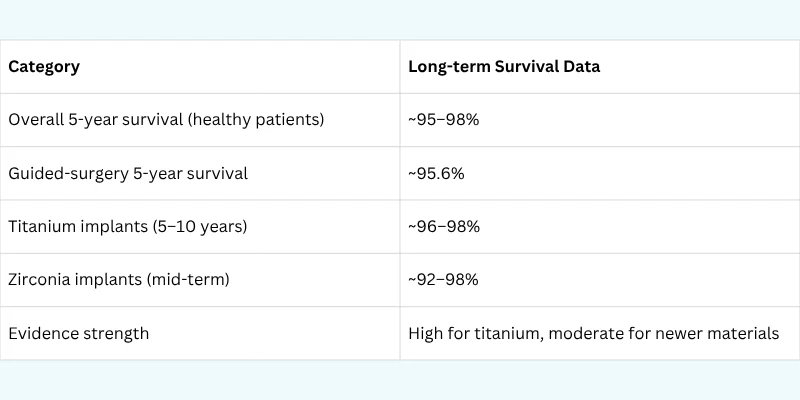
Overall, dental implants have an excellent long-term prognosis. Multiple clinical studies and meta-analyses report 5‑year survival rates of ~95–98% in healthy patients, regardless of arch or design.
For example, in guided-surgery cases, implants had an estimated 95.6% survival at 5 years. Titanium implants in posterior sites often achieve ~96–98% survival at 5–10 years in routine practice.
Zirconia implants and other novel materials also show similarly high mid-term survival rates (generally in the 92–98% range), though data are more limited.
Longevity tends to decrease gradually over time. The leading causes of late failures are biological (peri-implantitis) and mechanical complications (screw or implant fracture).
One large series found that beyond the first year post-placement, implant failures occur at roughly 0.5–1.0% per year on average. Thus, a 10-year cumulative survival is often on the order of 90–95%.
For example, zygomatic implants had an estimated annual failure incidence of ~0.7%; extrapolating suggests ~96% survive 5–6 years, and ~90–95% may survive 10+ years.
In full-arch supported cases, survival is similarly high: one systematic review noted only a slight decrease in survival beyond 10 years, but data were limited.
Survival can differ by implant system and location. Mandibular (lower-jaw) implants often fare a bit better than maxillary (upper-jaw) ones, due to denser bone.
Implants placed with extensive bone grafting or sinus lift also carry higher risk of delayed healing but generally reach comparable survival if grafting succeeds.
Computer-aided planning and immediate loading have made even complex, grafted cases as predictable as straightforward ones, when done by experienced clinicians.
Overall, modern implants placed with advanced protocols have 10–15 year survival in the high 90s for selected sites and patients, though true “lifetime” data (20+ year) are still sparse.
Retreatment Rates and Complications
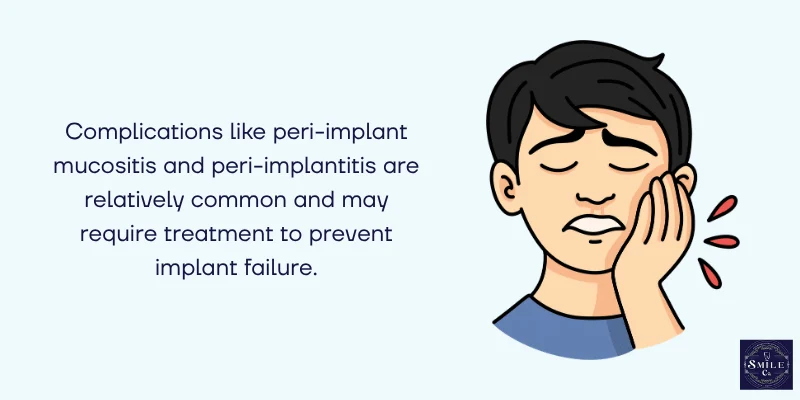
Despite high survival, failures and complications do occur and may require retreatment. Peri-implant disease is the most common biologic complication.
In the U.S., roughly 22–27% of patients with implants develop peri-implantitis (bone loss around the implant), and over 45% develop mucositis (gum inflammation) at some point.
On an implant level, peri-implantitis prevalence is around 18%. These conditions often necessitate non-surgical or surgical therapy to halt progression.
Left untreated, peri-implantitis can lead to implant loss, but with appropriate maintenance and therapy, most implants remain serviceable.
Mechanical complications (prosthesis-related) are also notable. These include screw loosening, porcelain fracture on crowns or bridges, and occasional implant body fracture.
Estimates vary, but mechanical issues may occur in up to 10–15% of full-month restorations over 5–10 years.
When implants fail (typically early, during osseointegration, or late from infection/mechanics), many clinicians attempt reimplantation at the same site.
A systematic review found that dental implants placed in sites of previous failure still had a high success rate (~86–90% survival after retreatment at 1–5 years).
In other words, most failed sites can be successfully re-drilled and re-implanted, although smoking, advanced age, and poor bone quantity can reduce retreatment success.
Risk factors for complications are well documented. A history of periodontitis and poor oral hygiene is strongly linked to peri-implantitis. Cigarette smoking roughly doubles the risk of implant failure.
Uncontrolled diabetes and immunosuppression also modestly increase implant loss risk. Patients with systemic risk factors or poor motivation for maintenance should be counseled accordingly.
Importantly, regular recall and hygiene care dramatically reduce peri-implant disease incidence.
Clinicians must weigh these factors when planning advanced procedures, and often coordinate with medical colleagues to optimize patient health before and after surgery.
U.S. Trends vs. Greenville, SC Context
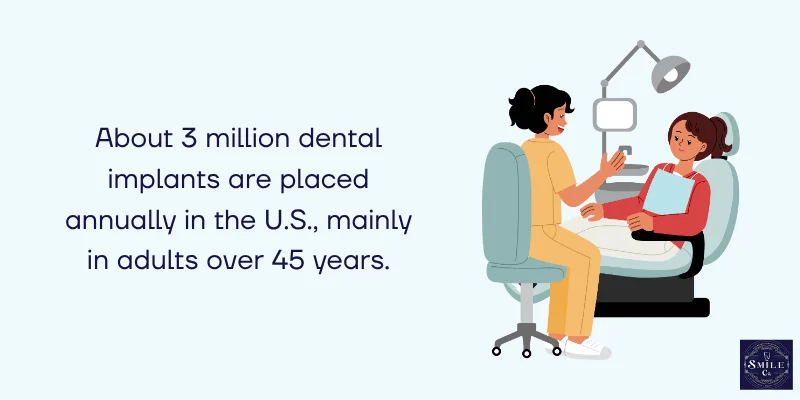
National trends: In the U.S., dental implants have rapidly grown. Recent reports estimate ~3 million dental implants are placed yearly (in roughly 1 million patients).
This is a huge increase from the early 2010s (500,000 patients/year).
Implants are now effectively a standard of care for eligible patients, partly due to higher provider experience and patient demand.
Implants are preferred over bridges or dentures by a large margin: the American Academy of Implant Dentistry notes implants’ longevity and function make them the favored solution for tooth loss.
Adoption is not uniform. Older patients (especially 45+) receive the bulk of implants (70% of recipients are age 45+). Implants remain expensive, so usage skews toward higher-income and insured groups.
Only a minority of edentulous or partially dentate individuals currently choose implants; one analysis suggests only ~2–3% of Americans with missing teeth have implants.
Projections indicate this will rise (e.g. to ~17% of missing-teeth adults by 2026), as costs modestly decrease and technology improves.
Access in Greenville, SC: Greenville County (pop. ~700K) is South Carolina’s most populous county and has many dental specialists. However, statewide data highlight notable access gaps.
For example, 86% of SC Medicaid-enrolled adults had no dental visit in 2023, reflecting severe underutilization. Moreover, about 1.6 million South Carolinians live in areas deemed dental “shortage zones”.
While Greenville itself has relatively more providers than rural counties, nearby rural or low-income communities likely face difficulty accessing specialized implant care. Insurance coverage further limits treatment.
Medicaid in SC does not cover implants, and many private plans exclude them or require heavy copays.
As a result, socioeconomic disparities exist: wealthier patients and those with any supplemental plan can obtain advanced treatments like all‑on‑4 or guided full-arch implants, whereas lower-income patients often rely on extractions or conventional dentures.
Geographically, urban areas (e.g., metro Greenville) have more periodontists and oral surgeons offering advanced implant services, whereas rural upstate communities may lack local specialists.
Patients from rural or Appalachian parts of SC sometimes travel to Greenville or Charlotte for implant care.
These access factors suggest that advanced-procedure utilization will be concentrated in population centers, with slower uptake in underserved areas.
In summary, Greenville area patients have better than average access within SC, but still contend with statewide workforce shortages and insurance barriers that many other Americans face.
Future Outlook (Beyond 2026)
Looking ahead, demand for advanced implant solutions is expected to continue rising.
Key drivers include the aging “Baby Boomer” population (projected U.S. 65+ to outnumber under-18 by 2030), and the growing middle-class seeking fixed, aesthetic tooth replacement.
The U.S. dental implant market is forecast to grow in the high single digits annually. Ongoing innovations, from 3D printing and intraoral scanning to AI-guided treatment planning, promise to make procedures faster, cheaper, and safer.
For example, fully digital workflows and robotic-guided systems are being refined, which should increase efficiency and consistency of implant placement.
Antibacterial coatings and better biomaterials may further reduce complications.
With more implants in service, we also expect a rise in long-term follow-up data. Some models project that by 2030 the prevalence of implant use among U.S. adults with missing teeth could reach 20–25%.
This implies a growing population of elderly patients with decades-old implants. Consequently, clinicians should prepare for more retreatment and maintenance challenges (e.g. replacing aging prostheses, managing peri-implantitis in older patients).
Public health efforts may increasingly focus on training and workforce expansion to address the uneven access issues highlighted above.
In conclusion, advanced implant procedures now yield very high success and survival rates (typically mid-to-high 90% at 5–10 years).
However, retreatment and maintenance remain important: roughly 18–27% of patients experience peri-implant disease, and mechanical failures require occasional intervention.
In the U.S., these technologies are mainstream, national usage is surging, but barriers of cost and provider availability still leave many (including in South Carolina) without access.
Future research will need to monitor long-term outcomes beyond 2026 as more data accrue, and to address disparities so that implant longevity can benefit broader patient populations.
Sources: Recent peer-reviewed reviews and consensus statements on implant survival and complications[1][4][2][6], plus U.S. oral health access reports.
References
[1] Systematic review of short- (5–10 years) and long-term (10 years or more) survival and success of full-arch fixed dental hybrid prostheses and supporting implants – ScienceDirect
Long-term Treatment Outcomes with Zygomatic Implants – Consensus Statements – ITI
NCRDSCB: 2021 Period Review of Dental Specialty Education and Practice Report
Outcomes of implants placed in sites of previously failed implants
Influence of Diabetes on Implant Failure and Peri-Implant Diseases