



When you plan for a dental implant, accuracy matters. You want the implant in the right spot, at the right angle, and clear of nerves and sinuses. Traditional 2D images can miss depth and detail.
3D scans change dental implant planning accuracy by giving you a full view of your bone, nerves, and jaw structure, so your dentist can plan and place the implant with greater precision.
You see a digital model of your mouth, not just a flat image. This clear view helps guide decisions before surgery even starts.
With 3D imaging, your dentist can measure bone levels, choose the right implant size, and map out the safest path for placement.
These 3D dental implant scan benefits help create a treatment plan based on detailed data instead of guesswork. That careful planning can support safer surgery and more predictable results.
Key Takeaways
- 3D imaging gives a detailed view of your jaw and surrounding structures.
- Digital planning improves implant position and angle before surgery.
- Careful planning with 3D scans supports safer and more predictable outcomes.
Fundamentals of 3D Dental Imaging for Implants
Accurate implant planning depends on clear views of your bone, nerves, and sinus spaces. 3D imaging gives your dentist detailed data that flat images cannot provide.
What Is 3D Imaging in Dentistry
3D imaging in dentistry creates a three-dimensional view of your teeth, jawbone, and nearby structures. Instead of a flat picture, you see depth, width, and height in one scan.
Most implant planning uses cone beam CT (CBCT). A CBCT scan rotates around your head and captures many images in seconds. Software then builds a detailed 3D model of your mouth.
This model shows:
- Bone thickness and density
- Nerve pathways
- Sinus position
- Root shape and angle
According to research on the impact of 3D imaging techniques and virtual patients, 3D planning improves accuracy in implant placement. That matters because small errors in angle or depth can affect stability and safety.
With 3D dental imaging, your dentist measures exact distances before surgery begins.
Types of 3D Dental Imaging Technologies
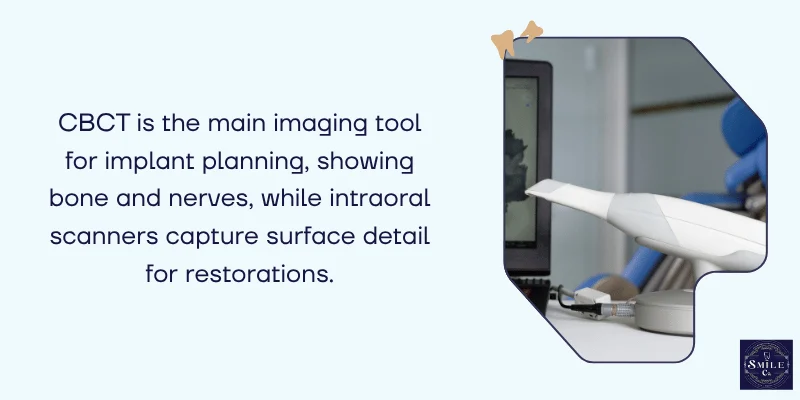
You may hear several terms used for 3D dental imaging. The most common for implants is CBCT, also called cone beam CT.
A CBCT scan focuses on hard tissues like bone. It uses a cone-shaped X-ray beam to capture the entire jaw in one rotation. Dentists rely on it because it provides precise detail with relatively low radiation compared to medical CT scans.
Some offices also use digital intraoral scanners. These scanners create a 3D image of your teeth and gums. They do not show bone, but they help design crowns and surgical guides.
Many implant centers explain that 3D imaging improves dental implant placement by revealing bone, nerves, and soft tissue in one view. That full view helps your dentist choose the correct implant size and position.
Each technology plays a role, but CBCT remains the main tool for implant planning.
Comparison With Traditional X-Rays
Traditional dental X-rays create flat, two-dimensional images. They show height and general bone levels, but they do not show depth.
With 2D X-rays, structures can overlap. A nerve canal may hide behind bone. The sinus floor may appear closer or farther than it really is.
A CBCT scan removes much of that guesswork. You can see cross-sections of the jaw from different angles. This helps your dentist avoid critical structures and plan safer placement.
Clinics that describe the role of 3D imaging in planning dental implants note that it reduces the risk of nerve and sinus damage. It also allows for custom surgical guides that control the angle and depth.
In simple terms, traditional X-rays show a picture. 3D imaging shows a model you can measure and rotate.
Digital Implant Planning and Virtual Simulation
Digital tools let you plan implant placement on a computer before you ever touch the patient. You can test position, angle, and depth in a controlled setting and reduce guesswork during surgery.
Role of Digital Planning Software
Digital planning software lets you combine CBCT scans with intraoral scans into one detailed 3D view.
Many systems allow you to merge scan data and position implants with millimeter precision inside a virtual model, as explained in this article on virtual treatment planning software.
You can adjust implant size, angle, and depth while checking bone volume and nearby structures like nerves or sinuses. The software shows how your implant plan lines up with the final crown.
That helps you plan from the prosthetic result backward, not just from the bone forward.
Modern digital workflows also support guided surgery. Reviews on digital workflow in implant planning and execution describe how clinics use this process to improve precision and reduce treatment time.
Key benefits for you include:
- Clear visualization of anatomy
- Measurable implant positioning
- Better communication with labs and patients
Creating Virtual Patients and 3D Models
When you create virtual patients, you build a full digital replica of your patient’s mouth. You use CBCT data, digital impressions, and surface scans to generate a single 3D model.
Research on the impact of 3D imaging techniques and virtual patients shows that these tools improve accuracy during implant placement. You can study bone contours, identify defects, and evaluate spacing before surgery.
Three-dimensional digital planning also supports detailed image segmentation and visualization.
A review of three-dimensional digital applications for implant space planning explains how clinicians analyze CBCT images and digital dental models to assess available implant space.
With a virtual patient, you can:
- Simulate implant placement step by step
- Test different implant diameters and lengths
- Plan surgical guides based on your final design
This process makes your dental implant planning more controlled and predictable because you rehearse the procedure before entering the operatory.
Accuracy and Benefits in Dental Implant Placement
3D scans let you see the exact bone shape, nerve paths, and sinus space before surgery. This detail improves implant placement, lowers risk, and supports a clear personalized treatment plan.
Precision Placement and Guided Surgery
When you use a 3D scan, you move beyond flat X‑rays. A CBCT scan creates a full view of your jaw in three dimensions, which helps you plan the exact angle, depth, and position of each implant.
This level of detail supports more accurate dental implant placement. According to research on the impact of 3D imaging techniques and virtual patients, digital planning tools improve precision and reduce placement errors.
You can also pair the scan with guided surgery. Instead of placing the implant by sight and feel alone, you follow a preplanned path based on the digital model.
Key benefits include:
- Better control of implant angle
- Reduced risk of hitting nerves or sinuses
- More predictable fit for the final crown
Guided surgery helps you place implants where bone support is strongest. That improves stability from day one.
Assessing Jawbone and Bone Density
A 3D scan shows more than surface bone. It reveals the width, height, and shape of your jawbone in each area where you plan implant placement.
You can also evaluate bone density. Dense bone often gives better initial stability, while softer bone may need a different implant type or healing plan.
A detailed scan, such as a CBCT scan for dental implants, helps you measure these factors before surgery. You can check how close the implant site sits to:
- The inferior alveolar nerve
- The maxillary sinus
- Adjacent tooth roots
This information shapes your personalized treatment plan. If bone volume is low, you can plan grafting in advance instead of discovering problems during surgery.
Clear imaging reduces guesswork. You make decisions based on visible anatomy, not estimates.
Surgical Guide Design
After you complete digital planning, you can design a custom surgical guide. This guide fits over your teeth or gums and directs the drill to the exact planned position.
3D scans support the role of 3D imaging in dental implant surgery by allowing you to transfer the digital plan directly into the patient’s mouth.
A surgical guide controls:
- Entry point
- Drill depth
- Implant angle
This structure reduces small hand movements that can shift placement. Even minor angle changes can affect how the final crown fits.
When you use a well-designed guide, implant placement follows the digital blueprint. That alignment improves function, supports long-term stability, and helps the final restoration match your bite more closely.
Managing Challenging Cases With 3D Scanning
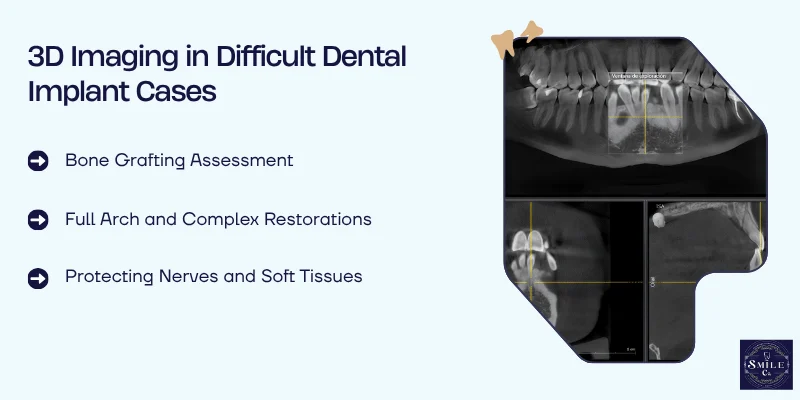
Complex implant cases demand clear data about bone, nerves, and soft tissue. With a detailed CBCT scan and digital surface scans, you can measure, map, and plan with fewer surprises during surgery.
Bone Grafting Assessment
When bone volume is low, guessing is not safe. A CBCT scan lets you measure bone height, width, and angulation in millimeters.
You can check bone density in the planned implant site and compare it to nearby areas. This helps you decide if you need bone grafting and what type of graft will work best.
3D scans also show the true shape of the jaw structure. You can see thin ridges, undercuts, and sinus position in the upper jaw. That detail guides decisions about sinus lifts or ridge augmentation.
Studies on the accuracy of 3D printed medical models show how digital data can be used to evaluate physical models. When you print a model from your scan, you can test the implant position and graft volume before surgery.
This planning reduces chair time and lowers the risk of placing implants in weak or uneven bone.
Full Arch and Complex Restorations
Full arch cases require more than a single implant plan. You must evaluate the entire jaw structure, bite position, and available restorative space.
By combining CBCT data with intraoral scans, you create a digital patient. Articles on 3D facial scans in full arch digital workflow explain how facial and jaw data improve planning for complex cases.
You can:
- Plan implant distribution across the arch
- Check parallelism and angulation
- Assess prosthetic space before surgery
This approach helps you design a stable foundation for fixed bridges or full arch prostheses. It also helps you avoid placing implants too close together or in poor quality bone.
For immediate load cases, precise digital planning improves fit and reduces adjustments at delivery.
Protecting Nerves and Soft Tissues
In the lower jaw, the inferior alveolar nerve runs close to common implant sites. A CBCT scan shows its exact path in three dimensions.
You can measure the distance from the planned implant to the nerve canal. This reduces the risk of numbness or long-term nerve injury.
The scan also shows sinus floors, nasal cavities, and adjacent roots. In the upper jaw, this detail helps you avoid sinus perforation.
3D imaging supports safer workflows in implant dentistry. Accurate digital planning protects both hard and soft tissues.
When you respect these anatomical limits during planning, you lower surgical stress and improve patient safety.
Patient Outcomes and the Future of Implant Surgery
3D scans change what you experience before, during, and after dental implant surgery. They support faster recovery, improve comfort, and help your dental implant center plan treatment with clear, measurable steps.
Faster Recovery and Comfort
When your dentist uses 3D imaging, you get a detailed view of your jaw, nerves, and sinus spaces before surgery begins. This level of planning reduces guesswork and limits unnecessary tissue movement.
Cone Beam CT plays a major role in this process. The CBCT scans show structures that 2D X-rays can miss. With that data, your provider places the implant in a precise position.
More precise placement often means:
- Smaller surgical openings
- Less swelling
- Lower risk of nerve injury
- Faster recovery time
You may return to normal eating and speaking sooner because your dentist avoids critical areas. This careful approach supports comfort in the first few days after surgery and lowers the chance of unexpected problems.
Predictable Results and Long-Term Success
Accuracy affects how well your implant functions over time. If your implant sits at the correct angle and depth, it can support chewing forces evenly and protect nearby teeth.
Research reviewed by PMC on 3D imaging techniques and virtual patients shows that 3D planning improves placement accuracy. Higher accuracy reduces positioning errors that can affect stability and long-term success.
At your dental implant center, digital planning tools allow your provider to measure bone width, height, and density before surgery. That data helps determine:
- The correct implant size
- The safest placement angle
- The need for bone grafting
When your provider plans each step in advance, you get predictable results. Predictability lowers stress and helps you understand what to expect from start to finish.
Advancements in Technology and Future Trends

3D scans already improve implant planning, but technology continues to advance. Some practices now combine digital scans with CAD-CAM surgical guides to control implant depth and direction.
Studies on 3D printed surgical guides and placement accuracy show that guided systems can improve precision compared to traditional guides. These tools help transfer the digital plan directly to your mouth during surgery.
Emerging systems also include dynamic navigation and robotic support. Reviews of dynamic and robotic computer-assisted implant surgery describe how real-time tracking may increase control during placement.
As these tools improve, you can expect:
- More consistent surgical outcomes
- Shorter procedure times
- Better communication through digital simulations
The benefits of 3D imaging continue to shape how dental implant surgery is planned and performed. You gain clearer treatment plans and a more controlled surgical experience as technology moves forward.
Frequently Asked Questions
3D scans give your dentist a clear, three-dimensional view of your jaw before implant surgery. They show bone height, width, density, and the exact location of nerves and sinuses so your treatment plan fits your anatomy.
What’s the difference between a 3D dental scan and a traditional 2D X-ray for implant planning?
A traditional 2D X-ray shows a flat image. It can reveal bone height, but it does not show bone width or depth.
A 3D scan, often called a CBCT scan, shows your jaw in three dimensions. It displays bone width, density, nerve position, and sinus location, which a flat image cannot fully show.
How do 3D scans help dentists choose the safest and most precise implant placement?
A 3D scan maps your jaw before the first incision. Your dentist can measure bone height and width and select the right implant size.
It also supports guided planning. Many practices rely on implant planning with 3D imaging to improve accuracy and lower surgical risk.
With this data, your dentist places the implant at the correct angle and depth.
Can a 3D scan show whether I have enough bone for an implant?
Yes. A 3D scan shows how tall, wide, and dense your bone is in the exact area of the missing tooth.
This detailed view helps your dentist decide if your bone can support an implant or if you may need extra treatment.
Modern practices explain how 3D imaging improves dental implant placement by giving this full picture of your jaw.
You get a clear answer based on measurements, not guesswork.
How do 3D scans help avoid nerves and sinuses during implant planning?
Your lower jaw contains a major nerve. Your upper back jaw sits close to the sinus cavity.
A 3D scan shows the exact path of the nerve and the floor of the sinus. Dentists use this view to plan a safe distance from these structures. Clinical teams note that a CBCT scan for dental implants improves accuracy and supports careful planning in complex cases.
This reduces the risk of nerve injury or sinus problems.
Will a 3D scan reduce the chances of needing a bone graft or sinus lift?
A 3D scan does not change your bone, but it does give exact measurements. Your dentist can see bone limits before surgery.
In some cases, this clear map helps place the implant in the best available bone and may limit the need for extra procedures.
Many clinics describe the benefits of 3D imaging in dental implant planning as a way to tailor treatment to your specific anatomy.
You receive a plan based on real data from your scan.
Do 3D scans make the implant surgery faster or more comfortable?
A 3D scan allows your dentist to plan every step in advance. That planning can shorten the time spent adjusting during surgery.
When placement is precise, the procedure often runs more smoothly. Practices explain the role of 3D imaging in planning dental implants as a way to improve accuracy, comfort, and recovery.
You benefit from a plan built around your exact jaw structure.