


Dental implants have become a trusted solution for replacing missing teeth, but not everyone experiences the same success rates.
If you smoke or have diabetes, you might wonder whether these conditions will affect your chances of a successful implant.
The good news is that understanding how these factors impact your treatment can help you make informed decisions and take steps to improve your outcomes.
Research shows that both smoking and diabetes can significantly increase the risk of dental implant failure, but the degree of impact depends on factors like how well your diabetes is controlled and how much you smoke.
Studies have found that smokers experience higher failure rates compared to non-smokers, while poorly controlled diabetes elevates the risk of complications including peri-implantitis and implant loss.
The combination of both conditions can create even greater challenges for healing and long-term success.
The data paints a clear picture, but it doesn’t mean you can’t have successful implants. Many patients with these risk factors achieve excellent results when they work closely with their dental team and follow specific protocols.
Understanding what the research actually shows can help you prepare for treatment and maximize your chances of a positive outcome.
Key Takeaways
- Smoking and diabetes both increase dental implant failure risk through effects on healing and bone integration
- Well-controlled diabetes has minimal impact on success while uncontrolled blood sugar significantly raises complication rates
- Quitting smoking before surgery and maintaining good blood sugar control greatly improve your implant outcomes
Speak With a Greenville South Carolina Implant Dentist About Reducing Implant Failure Risk
Dental Implant Success and Key Influencing Factors
Dental implant outcomes depend on multiple biological and lifestyle factors working together.
The success of your implants relies heavily on proper bone healing, strong osseointegration, and how well you manage controllable risk factors.
What Determines Implant Success Rate
Your dental implant success rate depends on several measurable factors. Studies show that implant survival rates are influenced by systemic disorders, medication use, lifestyle habits, and implant design.
The typical success rate for dental implants ranges from 90% to 95% over a 10-year period. However, your individual results can vary based on:
- Bone density and quality at the implant site
- Location in the mouth (upper or lower jaw)
- Your overall health status and medical conditions
- Oral hygiene practices before and after surgery
- Experience of your dental surgeon
Your age, immune system function, and how well you follow post-surgical instructions also play important roles. The implant design itself matters too, with certain surface treatments showing better results than others.
Understanding Osseointegration and Implant Integration
Osseointegration is the process where your jawbone fuses directly with the titanium implant. This biological bond is what makes your implant stable and functional.
The osseointegration process typically takes 3 to 6 months. During this time, bone cells grow onto the implant surface and create a strong connection. Your bone healing capacity determines how well this integration happens.
Several factors affect osseointegration quality. Your bone density must be sufficient to support the implant. Blood supply to the area needs to be adequate for new bone formation.
Any condition that slows bone healing can interfere with proper implant integration.
Early implant failure usually happens when osseointegration doesn’t occur correctly. This can result from infection, too much movement during healing, or insufficient bone quality at the surgical site.
Impact of Risk Factors on Implant Outcomes
Certain risk factors significantly reduce your chances of successful dental implant outcomes. Smoking, diabetes, and bone loss are among the most common conditions that affect implant success.
Smoking restricts blood flow to your gums and bone. This reduced circulation slows healing and weakens the osseointegration process. Smokers face approximately 2 to 3 times higher failure rates compared to non-smokers.
Diabetes affects your body’s healing ability and immune response. Studies show implants in diabetic patients have a 77.7% higher risk of failure than in non-diabetic patients. Poor blood sugar control creates even greater risks.
Other risk factors include poor oral hygiene, gum disease, teeth grinding, and radiation therapy to the head or neck. You can reduce many of these risks through proper dental care and lifestyle changes before getting implants.
Book a Dental Implant Consultation to Review Your Risk Factors
The Impact of Smoking on Dental Implant Success
Smoking creates specific challenges for dental implants by disrupting essential healing processes and increasing infection risk.
Research shows smokers face 159% higher odds of early implant failure compared to non-smokers, with effects extending to bone integration and long-term implant stability.
How Nicotine and Smoking Affect Wound Healing
When you smoke, nicotine restricts blood flow to your gums and bone tissue. This reduced circulation means less oxygen and fewer nutrients reach the surgical site where your implant needs to heal.
The chemicals in tobacco smoke also weaken your immune response. Your body struggles to fight off bacteria and repair damaged tissue effectively. This creates a slower healing timeline after implant placement.
Nicotine interferes with fibroblast function, which are cells responsible for producing collagen. Without proper collagen production, your soft tissue around the implant can’t form the strong seal needed for long-term success.
Carbon monoxide from cigarette smoke further reduces oxygen levels in your blood, making it even harder for wounds to close properly.
These combined effects mean your risk of postoperative infection increases significantly when you continue smoking during the healing period.
Correlation Between Smoking and Implant Failure
The data on smoking and dental implants shows clear patterns of increased failure rates. Studies analyzing thousands of implants reveal that smokers experience implant failure at notably higher rates than non-smokers.
At the individual patient level, you’re twice as likely to experience early implant failure if you smoke. Early failure means the implant doesn’t integrate with your bone before the permanent crown is attached.
The location of your implant matters too. Upper jaw implants in smokers fail more frequently than lower jaw implants because the upper jaw has less dense bone and relies more heavily on good blood supply for healing.
Key failure rate factors include:
- Number of cigarettes smoked per day
- Duration of smoking history
- Whether you smoke during the critical healing phase
- Bone quality at the implant site
Peri-Implant Complications in Smokers
Peri-implantitis represents one of the most serious complications you might face with dental implants. This inflammatory condition affects the tissues and bone surrounding your implant, similar to gum disease around natural teeth.
Smoking dramatically increases your risk of developing peri-implantitis. The inflammation damages the bone supporting your implant, leading to marginal bone loss over time.
Your implant marginal bone loss tends to progress faster when you smoke. Research shows smokers lose more bone around implants compared to non-smokers during the first year after placement.
This bone loss can compromise the stability of your implant.
Signs of peri-implant complications include:
- Bleeding when you brush near the implant
- Swelling or redness of gum tissue
- Pus discharge around the implant
- Loosening of the implant crown
Poor peri-implant health in smokers stems from constant exposure to tobacco toxins that prevent proper tissue maintenance.
Benefits of Smoking Cessation for Implant Outcomes
Quitting smoking before your implant surgery gives your body the best chance for successful healing. Even short-term smoking cessation can improve outcomes, though longer periods without smoking show greater benefits.
Your blood flow begins to improve within weeks of quitting. This enhanced circulation delivers more oxygen and healing factors to your implant site, supporting better bone integration.
Former smokers who quit before implant placement show failure rates closer to non-smokers. The evidence suggests that stopping smoking at least several weeks before surgery and throughout the healing period reduces your implant complications significantly.
Bone healing improves substantially when you quit smoking. This becomes especially important if you need guided bone regeneration procedures to build up bone before implant placement.
The grafted bone integrates better and provides a stronger foundation for your implant when tobacco isn’t interfering with the healing process.
Learn How to Improve Your Dental Implant Success Rate
Diabetes and Dental Implants: Success, Survival, and Healing
Blood sugar levels play a major role in how well dental implants heal and survive long-term.
Patients with well-controlled diabetes can achieve success rates similar to non-diabetic patients, while poor glycemic control increases risks of complications and implant failure.
Glycemic Control and Implant Success Rate
Your HbA1c level is the most important predictor of implant success if you have diabetes. Studies show that when your HbA1c stays under 7%, your implant survival rates can reach 95%.
Well-controlled diabetes has minimal impact on clinical outcomes. Your body can heal properly when blood sugar remains stable before and after surgery.
Uncontrolled diabetes creates serious challenges. High blood sugar slows wound healing and affects bone metabolism around the implant. This makes it harder for the implant to integrate with your jawbone.
Key HbA1c targets for implant success:
- Under 7%: Optimal healing conditions
- 7-8%: Moderate risk, close monitoring needed
- Above 8%: Higher failure rates, may need to improve control first
Your dentist should check your HbA1c levels before scheduling implant surgery. Working with your doctor to stabilize blood sugar improves your chances significantly.
Type 2 diabetes and Dental Implant Outcomes
Type 2 diabetes mellitus affects implant success rates and marginal bone loss compared to patients without diabetes. Research shows you can still get implants successfully with proper management.
Your healing timeline may be longer with type 2 diabetes. The implant needs time to fuse with your bone through a process called osseointegration. Elevated blood sugar can slow this process down.
Marginal bone loss around implants tends to be greater in diabetic patients. This bone loss happens at the top of the implant where it meets your gum tissue. Regular monitoring helps catch problems early.
Well-managed diabetes has little effect on implant success, but you need consistent glycemic control. Your oral surgeon should coordinate with your primary care doctor throughout the process.
Peri-Implantitis and Poor Glycemic Control
Peri-implantitis is an infection around the implant that can cause bone loss and implant failure. Poor glycemic control makes you more vulnerable to this condition.
High blood sugar creates an environment where bacteria thrive. Your mouth becomes more susceptible to infections that damage peri-implant health. This inflammation can destroy the bone supporting your implant.
Warning signs of peri-implantitis:
- Bleeding when brushing near the implant
- Swollen or red gums around the implant
- Increased probing depth during dental exams
- Loose implant
You need to maintain excellent oral hygiene and control your blood sugar to prevent this complication. Regular dental checkups help catch early signs before serious damage occurs.
Prediabetes and Peri-Implant Health
Prediabetes elevates your risk for complications even though you don’t have full diabetes yet. Your blood sugar levels are higher than normal but not high enough for a diabetes diagnosis.
Research shows that prediabetes increases the likelihood of implant failure and peri-implantitis. Many people don’t realize prediabetes affects healing and infection risk.
Your body’s inflammatory response is already changing with prediabetes. This affects wound healing and bone metabolism around implants. Taking steps to improve your blood sugar now protects your investment in dental implants.
Close monitoring is essential if you have prediabetes. Your dentist may recommend more frequent follow-up visits to check probing depth and bone levels around your implants.
Combined Effects of Smoking and Diabetes on Implant Outcomes
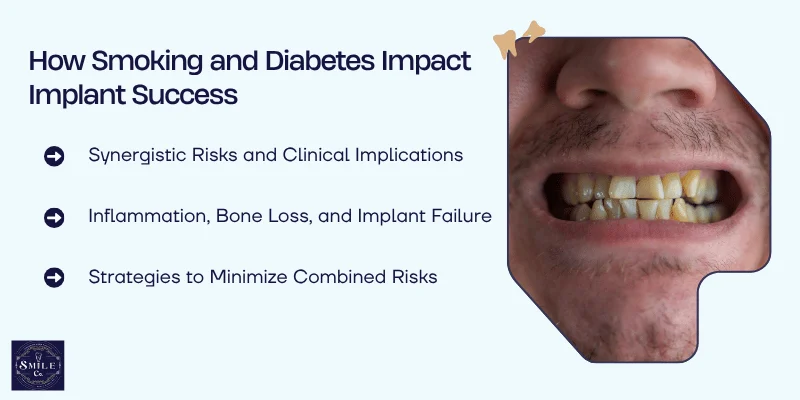
When you have both diabetes and smoking as risk factors, your chances of implant complications increase significantly beyond what either condition would cause alone.
The combination creates a more severe impact on healing, bone health, and long-term implant survival.
Synergistic Risks and Clinical Implications
Smoking and diabetes together create major risk factors that make dental implants less likely to succeed.
When you smoke and have diabetes, you face impaired healing, higher implant failure rates, and increased bone loss more frequently than patients with just one of these conditions.
The combination of nicotine-induced injury and poor glucose control creates what researchers describe as an enlarged effect.
Your body struggles with two separate mechanisms that both interfere with healing at the same time. Nicotine reduces blood flow to your gums and bone, while high blood sugar levels slow down your immune response and tissue repair.
Research shows that smoking increases implant failure rates by 123% on its own. When you add diabetes to the mix, your risk multiplies rather than just adds up.
Inflammation, Bone Loss, and Implant Failure
Your body experiences heightened inflammation when both conditions are present. This leads to faster marginal bone loss around your implants and increases your risk of peri-implantitis.
Diabetes affects your bone metabolism, making it harder for bone to integrate with the implant surface. Smoking reduces oxygen delivery to tissues, which further compromises bone healing.
Together, these factors create an environment where peri-implant disease develops more quickly and aggressively.
Key inflammatory effects include:
- Elevated cytokine levels that break down bone
- Reduced ability to fight bacterial infections
- Slower wound healing after implant placement
- Increased susceptibility to implant complications
The combination targets multiple stages of implant success, from initial healing to long-term stability.
Strategies to Minimize Combined Risks
You can improve your outcomes by addressing both risk factors before and after implant surgery. Quitting smoking at least two weeks before surgery helps your body heal better.
Controlling your blood sugar levels to an HbA1c below 7% significantly reduces complications.
Your dentist may recommend:
- More frequent follow-up appointments to monitor healing
- Antibiotic prophylaxis to prevent infections
- Longer healing periods before loading implants
- Professional cleanings every three months
Working closely with both your dentist and physician gives you the best chance of success. Some patients benefit from delaying implant placement until they’ve quit smoking or achieved better diabetes control for several months.
Optimizing Implant Success in At-Risk Patients
Success rates improve significantly when dental teams carefully assess risk factors, use advanced surgical techniques, and implement thorough aftercare protocols.
Proper patient selection, bone preparation strategies, and diligent hygiene practices form the foundation of positive clinical outcomes.
Importance of Patient Selection and Preoperative Assessment
Your dental team needs to evaluate multiple factors before placing implants.
A comprehensive assessment includes checking your blood sugar levels if you have diabetes, reviewing your smoking history, and examining your bone quality through imaging.
Age, systemic health conditions, smoking status, and prosthetic design significantly influence implant survival. Your dentist should measure your hemoglobin A1C levels if you’re diabetic to ensure proper glucose control before surgery.
Well-controlled diabetes has minimal impact on success rates, but poorly managed blood sugar increases complications.
If you smoke, your provider should discuss cessation programs. Quitting even temporarily before and after surgery improves blood flow to your gums and enhances bone healing.
Your medical history, current medications, and bone density all factor into whether you’re a good candidate for immediate implant placement or need additional preparation time.
Role of Bone Augmentation and Regeneration
When you lack sufficient bone volume, your dentist may recommend bone augmentation procedures. Guided bone regeneration uses barrier membranes and bone graft materials to create adequate support for implants.
These techniques are especially important if you have diabetes or smoke, since both conditions can slow bone healing and affect implant integration.
Your provider might use synthetic bone materials, processed donor bone, or your own bone from another site. The regeneration process typically takes several months before implant placement.
Studies show that anodized implant surfaces combined with proper bone preparation improve success rates in at-risk patients.
Your surgeon will monitor healing closely through follow-up appointments and imaging to confirm adequate bone formation before proceeding with implant dentistry.
Postoperative Care and Oral Hygiene
Your commitment to oral hygiene directly impacts long-term implant success. You need to brush twice daily, floss around implants, and use antimicrobial rinses as directed by your dentist.
Maintaining excellent oral hygiene and following post-surgery care instructions improves your chances of achieving successful dental implant outcomes.
Attend all scheduled follow-up visits so your provider can check for signs of infection or inflammation. If you have diabetes, keep your blood sugar levels stable throughout the healing period.
Avoid smoking for at least several weeks after surgery, though permanent cessation offers the best protection. Your dentist may prescribe antibiotics or special cleaning protocols based on your risk factors.
Report any unusual pain, swelling, or mobility of the implant immediately to prevent complications.
Understanding the Data: Evidence From Systematic Reviews and Meta-Analyses
Research on smoking and dental implants relies heavily on pooled data from multiple studies. The evidence shows specific patterns of risk, though most data comes from observational studies rather than controlled trials.

What Systematic Reviews and Meta-Analyses Reveal
A systematic review is a rigorous process that involves identifying and synthesizing all available evidence on a specific question.
When researchers combine this with meta-analysis, they can calculate more precise estimates of risk than any single study provides.
The data on smoking and dental implant failure shows consistent patterns. Most systematic reviews report that smokers face roughly twice the risk of implant failure compared to non-smokers.
The implant survival rate for non-smokers typically ranges from 95-98% over five years, while smokers see rates of 85-90%.
You’ll find that heavy smokers face even greater risks. Studies show a dose-response relationship, meaning more cigarettes per day equals higher failure rates.
Former smokers fall somewhere in between, with risk decreasing the longer they’ve quit.
Assessing Study Quality and Risk of Bias
Most evidence comes from non-randomized controlled trials and observational studies because you can’t ethically assign people to smoke. This creates challenges in assessing quality.
Researchers use tools like ROBINS-I to evaluate risk of bias in these studies. They also apply GRADE criteria to rate the certainty of evidence. Common problems include:
- Lack of standardized definitions for smoking status
- Inconsistent follow-up periods across studies
- Missing data on smoking intensity
- Confounding factors like oral hygiene and diabetes
Systematic review and meta-analysis methods should follow predefined protocols to ensure transparency. When you see high-quality reviews, they’ll clearly report how they handled these issues.
Current Gaps and Future Research Directions
Major gaps remain in understanding exactly how smoking causes dental implant failure. You’ll find limited data on specific mechanisms like impaired bone healing or reduced blood flow at implant sites.
Research needs more studies examining:
- Optimal timing for implant placement after quitting smoking
- Specific thresholds of cigarette consumption that increase risk
- Interactions between smoking and other risk factors
- Clinical outcomes beyond survival rates, including bone loss and complications
Few studies track patients long-term beyond five years. This makes it hard to know if smoking effects worsen over time or stabilize after initial healing.
Frequently Asked Questions
Smoking affects dental implants in several measurable ways, from reduced success rates to slower healing times. Here’s what the research shows about tobacco use and implant outcomes.
How does smoking affect the success rate of dental implants?
Smoking lowers the success rate of dental implants compared to non-smokers. Research shows that smoking has an adverse effect on implant survival and success, with the impact being more pronounced in areas with loose trabecular bone.
The main problem is that smoking reduces blood flow to your gums. This makes it harder for your body to deliver oxygen and nutrients to the implant site.
Smoking also slows healing and increases your risk of infection. These factors work together to raise the chance of implant failure.
Can light smoking still impact the healing process of dental implants?
Light smoking still affects your dental implant healing. There isn’t a safe level of smoking when it comes to implant success.
Even a few cigarettes per day can reduce blood flow to your gums. Your body needs good circulation to heal properly after implant surgery.
The chemicals in tobacco smoke interfere with your immune system. This makes it harder for your body to fight off bacteria and heal the surgical site.
What are the long-term risks of smoking on dental implant health and stability?
Long-term smoking increases your risk of peri-implant diseases. These are infections that develop around the implant over time.
Emerging studies link e-cigarette aerosols to peri-implant inflammation and crestal bone loss that can be comparable to or worse than conventional smoking. This shows that vaping isn’t a safe alternative for implant patients.
Bone loss around the implant can cause it to become loose over time. Once this happens, you may need additional procedures or even implant removal.
Are there any extra precautions smokers should take when getting all-on-4 dental implants?
You should quit smoking before getting all-on-4 implants. These implants support a full arch of teeth, so their success is even more important.
Talk openly with your dentist about your smoking habits. Conditions like smoking require open communication and an experienced clinician who understands how to handle these challenges.
Your dentist may recommend extra follow-up visits to monitor healing. They might also suggest medications or rinses to help reduce infection risk.
What does the latest research say about smoking and its effects on dental implant failure?
Recent research confirms that smoking remains a major risk factor for implant failure. Studies continue to show lower success rates in smokers compared to non-smokers.
The data is especially clear about the impact on bone quality. The effect of smoking on implant survival is more pronounced in areas of loose trabecular bone.
New studies also show that vaping carries similar risks to traditional cigarettes. This means switching to e-cigarettes won’t protect your implants.
Is there a safe period after dental implant surgery before one can resume smoking, and what do experts recommend?
Experts recommend quitting smoking entirely for the best implant outcomes. If you plan to resume smoking, you should wait as long as possible after surgery.
The first few weeks after implant placement are critical for healing. Your bone needs to grow around the implant to hold it in place.
Most dentists recommend waiting at least two weeks before resuming smoking, but longer is better. Some experts suggest waiting several months to give your implants the best chance of success.