

Tooth loss remains common in older Americans, though prevalence has declined over the decades.
Nationally, roughly 120 million people in the U.S. are missing at least one tooth (about one in three adults), and over 36 million have no natural teeth at all. In adults aged 65 and older, an estimated 12.9% had complete tooth loss in 2015–2018.
More recent data show that about 11% of 65–74 year‑olds and 20% of those 75+ have lost all teeth. As illustrated below, that is roughly “1 in 6” Americans age 65+ who are edentulous (older CDC data).
These national dental implant case statistics mask large disparities. For example, non‑Hispanic Black seniors lose teeth at much higher rates (over 25% edentulous) than non‑Hispanic Whites (≈10%).
Lower income and education are also strongly associated with tooth loss. Not surprisingly, South Carolina follows similar trends but often fares worse than U.S. averages.
For instance, recent data show 14.6% of South Carolina adults 65+ have had all their teeth removed – higher than the national ~12–13%.
South Carolina ranks low nationally (38th of 50 states) in senior dental retention, reflecting a relatively older, rural, and lower‑income population.
Only about 63% of South Carolina adults saw a dentist in the past year (2022), compared to ~66–69% nationally. This limited care correlates with higher rates of untreated decay and tooth loss.
In all populations, the leading causes of tooth loss remain dental caries (cavities), periodontal (gum) disease, and related factors like smoking.
Poor oral hygiene, chronic disease, and limited access to preventive care drive caries and periodontitis, which in turn cause tooth extractions.
Early research attributed dramatic 20th‑century declines in edentulism to fluoride, sealants, and better dental care. However, many older adults still lack a functional dentition (often defined as fewer than 20 teeth).
For example, the CDC estimates 38% of U.S. seniors have lost over half their teeth.
In Greenville/SC, specifically, exact local data are scarce, but state surveys suggest South Carolina has higher-than-average tooth loss among seniors and underserved groups, driven by similar risk factors (smoking, diabetes, Medicaid barriers, etc.).
Treatment Planning Methods for Tooth Replacement
Modern dental implant treatment planning combines thorough assessment, imaging, and digital tools.
In the U.S., a multidisciplinary approach is standard: a surgeon, prosthodontist, and often a periodontist (or other specialists) confer from the outset to determine the patient’s needs.
Treatment planning typically proceeds through several key steps:

· Comprehensive examination. Review the patient’s medical/dental history, exam of remaining teeth, gums, and bite. Identify all risk factors (e.g., periodontitis, bruxism) and treat periodontal disease or infections before implant placement.
If the patient’s oral hygiene is poor, stabilization and reevaluation may precede implant planning.
· Restorative planning. Decide on the final prosthesis early (fixed crown/bridge vs removable denture). This “top-down” planning ensures implants are positioned to optimally support the intended restoration.
At this stage, practitioners also discuss alternatives (e.g., conventional bridge or denture) if implants prove unsuitable.
· 3D imaging and diagnostics. Obtain high-resolution imaging (panoramic X-ray and cone-beam CT) to measure bone volume and anatomy.
CBCT scans are now routine in U.S. implant planning; they reveal vital structures (nerves, sinuses) and bone quality so the dentist can virtually simulate implant placement.
Advanced planning software (CAD/CAM) and dental technology merges intraoral scans with CBCT data for precise visualization of hard and soft tissues.
This digital workflow greatly reduces surprises at surgery by allowing a “test-drive” of implant placement in software.
· Digital treatment planning. Using specialized software, the clinician virtually positions the implant(s) to achieve ideal prosthetic and surgical outcomes.
Computer-aided design (CAD) is often used to design custom abutments and crowns, and computer-aided manufacturing (CAM) can produce surgical guides or final restorations with micron-level accuracy.
Surgical guides are 3D‑printed templates that fit over the teeth or gums and direct drills along the planned path. In complex cases, such guides help ensure the implant angles, depth and position are exactly as planned, improving safety and efficiency.
· Case complexity classification. Before surgery, cases are classified by difficulty. One widely used system is the ITI “SAC” tool (Straightforward, Advanced, Complex).
The SAC assessment is essentially a checklist of prosthetic and surgical considerations (esthetic demands, bone quality, spacing, general health, etc.) that assigns a complexity category.
This helps the clinician decide whether a case is within general practice capability or needs specialist involvement.
As one ITI blog notes, SAC “checks various factors and considers all prosthetic and surgical complications…establish[ing] the degree of complexity of cases” to guide planning.
(In Greenville and across the U.S., dentists commonly use the SAC or similar frameworks as a systematic decision aid.)
· Team review and final plan. Finally, the team reviews all findings and finalizes the plan: number/size of implants, need for grafts or sinus lifts, timing of extractions vs implants, and so on.
A timeline is set (e.g., extract now vs stage, graft vs not) along with contingencies (what to do if the bone turns out to be insufficient, etc.). At each stage, the plan is updated with new information (e.g., healing progress).
These steps leverage digital tools but remain fundamentally about careful diagnosis and coordination. In
Greenville-area clinics, the same methods apply: dentists will use CBCT scans, CAD/CAM guides, and SAC classification just as in other U.S. centers.
Local factors (insurance, laboratory resources) may vary, but best practices in implant procedure are consistent nationwide.
Implant Case Complexity
“Case complexity” in implant dentistry refers to how challenging the surgery and restoration will be. Complexity depends on anatomical factors, patient health, and prosthetic requirements.
Simple cases (SAC “Straightforward”) might involve placing one implant in an area with ample bone and space, with no major esthetic demand.
Complex cases (“Advanced” or “Complex”) might require multiple implants, bone grafting, sinus lifts, or careful esthetic planning in the smile zone.
Several classification schemes quantify this. As noted, the ITI SAC tool is one approach: it flags implants needing specialist care if certain criteria are met (e.g. deep bite, proximity to neurovascular structures, severe bone loss, history of periodontitis).
Another new framework is the IDSC Complexity Index (Implant Dentistry Study Consortium): it explicitly classifies implant sites into five zones.
Class I (least complex) includes anterior mandible sites; Class V (most complex) are posterior maxilla sites requiring sinus augmentation.
Hussaini et al. (2024) collected data on over 20,000 implants and used the IDSC index to quantify complexity. Their results illustrate the impact of complexity on treatment.
For example, Class V cases (posterior maxilla with sinus lift) averaged 50 minutes of surgical time and cost $1,251, often requiring multiple surgeries (3.0 procedures per implant on average).
In contrast, Class I cases (easy anterior sites) averaged just 19 minutes and $790, with essentially one procedure needed. In short, higher complexity escalates time, cost, and interventions.
Another way to view complexity is via “roadmap” algorithms. Durham et al. describe algorithmic checklists to plan single-tooth, partial-arch, and full-arch cases.
Such protocols ensure all factors (available bone, opposing dentition, patient expectations) are evaluated.
For instance, one must decide early if a site’s condition mandates grafting or if a less invasive prosthetic (like a removable overdenture) is preferable.
In practice, complex cases (according to SAC or IDSC) are often referred from general dentists to specialists. In
Greenville, large group practices and specialists (periodontists, oral surgeons) handle most high-complexity implants, while general dentists manage simpler cases.
Key factors influencing complexity include:
· Bone quantity/quality. Poor bone (e.g., vertical atrophy) often requires grafts or zygomatic implants, adding complexity.
· Anatomical challenges. Proximity to sinuses, nerves, or vital structures (as in Class V sites) elevates complexity.
· Esthetic demands. Front-tooth implants in patients with high smile lines need meticulous placement and often gum grafting.
· Medical status. Systemic health (diabetes, osteoporosis) or habits (smoking) can complicate healing.
Altogether, case complexity guides not only the technical plan but also patient consultation (risks, timeline).
It is routinely assessed and documented in implant treatment planning in the U.S., and the same applies locally in Greenville-area dentistry.
Treatment Planning and Complexity: U.S. vs Greenville
While the principles of planning and complexity assessment are the same nationwide, local market factors can influence how care is delivered.
For example, South Carolina does not cover dental implants in Medicaid, so uninsured or low-income patients may delay implants and instead resort to dentures; this can skew local demand patterns.
Conversely, Greenville has a relatively high dentist per capita (≈44.5 dentists per 100,000 in 2025, above the U.S. average), suggesting reasonable access to care.
Large corporate dental chains (DSOs) have also expanded rapidly in SC (≈15.4% growth in DSO-affiliated dentists from 2015–24), which may improve implant availability but also standardize treatment protocols through shared technology.
Clinicians in Greenville typically follow ADA and ITI guidelines just like those in other states. They rely on the same imaging and digital tools, and they use classification systems (SAC, etc.) developed by international implant study groups.
The main differences would be in the patient population: Greenville’s demographics (age distribution, health behaviors) might affect the mix of straightforward vs complex cases.
For instance, rural patients may present later in the disease course, requiring more grafting, whereas urban patients may receive implants sooner.
However, in the absence of local surveys, we assume Greenville broadly mirrors state and national patterns of risk factors (smoking rates, diabetes prevalence).
Implant Market Trends and Forecasts
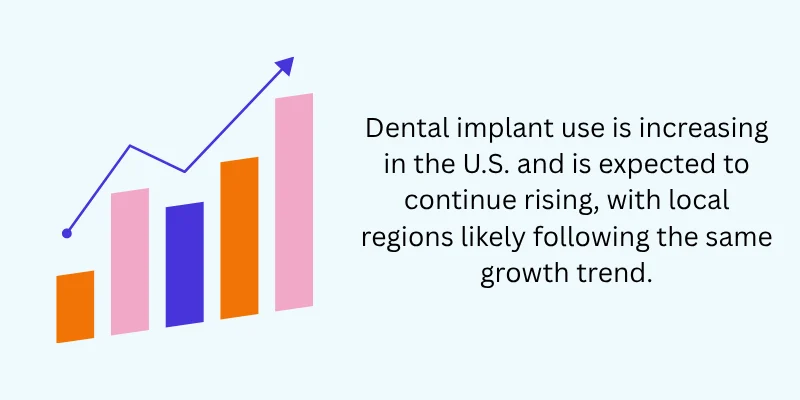
Dental implants have grown rapidly in popularity. A recent national analysis (using NHANES survey data) found the prevalence of implants among U.S. adults with missing teeth climbed from 0.7% in 1999–2000 to 5.7% in 2015–2016.
The increase was steepest in middle-aged and older groups: for 65–74 year-olds, implant prevalence rose by 12.9 percentage points, and among 55–64 year-olds, the rate increased nearly tenfold.
Projecting trends forward, this study estimated dental implant prevalence could reach 5.7%–23% of edentulous adults by 2026, depending on growth assumptions.
Even the lower end represents continued growth, reflecting greater patient demand and practitioner willingness.
These prevalence trends translate into a booming market. Globally, Grand View Research (2024) estimates the dental implants market was about $5.56 billion in 2025, rising to $6.02 billion by 2026, and growing at ~9% per year through 2033.
North America (led by the U.S.) is the largest regional market (~36% of revenue in 2025), driven by its large aging population and high per-capita spending on dental care.
In practical terms, industry reports predict billions of dollars in implant revenue and a continuing shortage of implant providers as demand grows.
Locally, Greenville and South Carolina are following this national trajectory. Although no specific forecasts are published for Greenville, the aging of the Baby Boomers suggests implant demand will rise.
Dentists in Greenville report seeing more implant consults each year, and often highlight implant technology (CBCT, 3D printing) in marketing.
On the consumer side, South Carolinians increasingly view implants as a standard option for missing teeth. Insurance expansions (e.g., high-cost private plans or new dental benefit products) could further boost uptake.
In summary, the U.S. continues to see rising implant use, with senior citizens driving much of the growth.
Greenville–area providers will likely experience parallel trends, albeit on a smaller scale, as local dentists and specialists respond to these nationwide patterns.
Ongoing research and data collection (e.g., state oral health surveys, practice audits) would be needed to track Greenville’s specifics in detail.
Conclusion
In conclusion, tooth loss remains a significant public health issue in the U.S., with older adults and disadvantaged groups most affected. U.S. data show a steady decline in edentulism over recent decades, but still millions of Americans lose all their teeth.
South Carolina (including Greenville) tends to have higher tooth loss rates and lower dental utilization than the national average.
Treatment planning methods in implant dentistry are highly standardized across the country: practitioners use multidisciplinary evaluation, 3D imaging, digital workflows, and case-classification tools (like the ITI SAC system).
Case complexity is likewise assessed using global indices (SAC, IDSC) and dictates the course of treatment; data show complex implant cases require far more time and resources.
Both nationally and locally, dental implant use is growing rapidly, fueled by the aging population and technological advances. Market analyses predict continued high growth through 2030.
This guide has synthesized recent US and Greenville-area information on these topics; although specific local studies are limited, the available evidence indicates that Greenville generally follows broader U.S. patterns in tooth loss and implant care.
Further local data collection (e.g., county health surveys, practice audits) could refine this picture for Greenville over the coming years.
Sources: Peer-reviewed studies, CDC oral health reports, state health data, and market analysis (see citations) were used to summarize U.S. tooth loss statistics, South Carolina oral health metrics, implant treatment planning approaches, and implant complexity findings.
Market and prevalence forecasts are drawn from recent analyses.
References
Facts & Figures | American College of Prosthodontists
Products – Data Briefs – Number 368 – June 2020
About Tooth Loss | Oral Health | CDC
Explore Teeth Extractions – Age 65+ in South Carolina | AHR
Explore Dental Visit in South Carolina | AHR
Dentists per capita in all 50 states – Becker’s Dental Review – DSO + Dental News
10 states seeing the most DSO growth – Becker’s Dental Review – DSO + Dental News