

Missing teeth can make you feel self-conscious about your smile. You might wonder if you need to wait months for a traditional implant or if you can get your new tooth in just one visit.
The good news is that dental technology has improved, giving you more options than ever before.
Same-day dental implants allow qualified patients to receive tooth removal, implant placement, and a temporary crown in a single appointment, while traditional implants require multiple visits spread over three to six months.
Your same day dental implants eligibility depends on several factors including your bone density, oral health, and the location of the missing tooth.
Not everyone is a good candidate for same-day implants, but many people can benefit from this faster option.
Understanding which type of implant works best for your situation helps you make a confident decision about your dental care.
The process, requirements, and candidate criteria differ between these two approaches, and knowing the differences can save you time and help set realistic expectations.
Key Takeaways
- Same-day implants offer immediate results in one visit while traditional implants take several months with multiple appointments
- Good bone density and overall oral health are the main factors that determine if you qualify for same-day implants
- Both implant types have high success rates when performed by experienced dentists on properly qualified patients
Understanding Same-Day and Traditional Dental Implants
The main difference between these two approaches comes down to timing and how many visits you need.
Same-day options let you walk out with new teeth in a single visit, while traditional implants require multiple appointments spread over several months.
What Are Same-Day Dental Implants?
Same-day dental implants, also called immediate load implants, are artificial tooth roots placed into your jawbone during the same appointment when your damaged tooth is removed.
Your dentist attaches a temporary crown or bridge right away, so you leave with a visible tooth instead of a gap.
This approach works because the implant is positioned in your fresh tooth socket immediately after extraction. The timing helps preserve your bone structure and gum shape.
Teeth in a day procedures can replace a single tooth or multiple teeth at once.
All-on-4 is a popular same-day option for people missing most or all of their teeth. It uses four strategically placed implants to support a full arch of replacement teeth. You get a complete set of functional teeth in one appointment.
The temporary tooth attached on the same day looks natural but isn’t meant for heavy chewing. You’ll need to eat soft foods while your implant fuses with your bone over the next few months.
What Are Traditional Dental Implants?
Traditional dental implants follow a longer but well-established process that typically takes three to six months to complete. Your dentist places the metal post into your jawbone during the first surgery, then your gums are stitched closed over it.
You wait several months while your bone grows around and fuses with the implant. This healing period, called osseointegration, creates a strong foundation for your new tooth.
After healing is complete, you return for a second minor procedure to attach an abutment (connector piece).
Finally, your dentist places the permanent crown on top. This step-by-step approach gives your body time to fully integrate the implant before applying any pressure.
Traditional implants are strong, stable, and can last for many years when properly cared for.
Immediate Load Implants vs Traditional Implant Procedure
The key differences between these methods affect your treatment timeline, number of visits, and healing approach:
Timeline:
- Same-day: Extraction, implant placement, and temporary tooth in one visit
- Traditional: 3-6 months total with multiple separate appointments
Number of Visits:
- Same-day: Usually one surgical visit, plus follow-ups
- Traditional: Two or three surgical procedures spread over months
Immediate Function:
- Same-day: You get a temporary tooth right away for appearance
- Traditional: You may wear a removable partial denture during healing
Both methods result in permanent implants that work like natural teeth.
The traditional approach gives your bone more time to heal before supporting a tooth, while same-day placement takes advantage of your body’s immediate healing response after extraction.
Unsure if you qualify for same day dental implants? Make an appointment today for a personalized evaluation.
Key Differences Between Same-Day and Traditional Implants
The main difference comes down to timing and how your body heals around the implant. Traditional implants require you to wait several months between surgeries, while same-day options let you leave with a tooth the same day.
Treatment Timeline
Traditional dental implants typically require multiple visits spread across three to six months. During your first appointment, your dentist performs implant surgery to place a titanium post into your jawbone.
You’ll then wait several months for the bone to heal and fuse with the implant before returning for your final tooth.
Same-day implants work much faster. You can get your implant placement and a temporary tooth attached during a single visit. This means you walk out of the office with a functioning tooth instead of waiting months.
However, not everyone qualifies for this faster approach since it requires sufficient bone density and specific jaw conditions.
Temporary Crown and Final Restoration
With traditional implants, you might receive temporary crowns or dentures during the healing period between surgeries. These placeholders let you eat and speak normally while your jawbone heals.
Once healing is complete, your dentist attaches the permanent crown or bridge.
Same-day implants give you a temporary crown immediately after implant placement. This tooth looks natural but you’ll need to be careful with it during the healing process. You should avoid eating hard foods on that side of your mouth.
After a few months, your dentist will replace this with your final restoration once the implant has properly fused with your bone.
Healing and Osseointegration
Osseointegration is the process where your jawbone grows around and fuses with the titanium implant post.
Traditional implant procedures allow complete osseointegration before adding any pressure to the implant. This typically takes three to six months and results in maximum stability.
Same-day implants load the implant immediately, which means you’re putting some pressure on it right away. The implant still needs time to integrate with your bone, but you have a tooth attached during this process.
This can work well for many patients, but the immediate loading may lead to higher failure rates in some cases compared to traditional methods that allow undisturbed healing.
Who Qualifies for Same-Day Dental Implants?
Not everyone can get same-day dental implants, even if you want them. Your eligibility depends on specific health factors, bone quality, and overall dental condition that your implant dentist will evaluate.
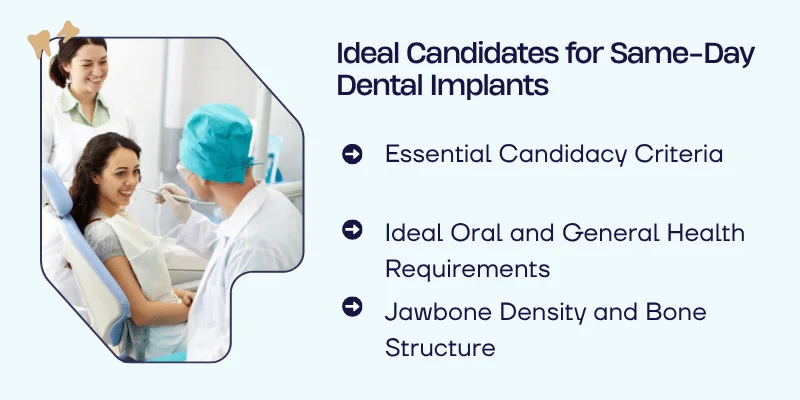
Alt-text: ideal-candidates-for-same-day-dental-implants
Essential Candidacy Criteria
You need to meet several basic requirements before your dentist will consider you for same-day implants.
First, you must be in good overall health without conditions that slow healing, like uncontrolled diabetes or autoimmune disorders.
If you smoke, you’ll likely need to quit before the procedure. Smoking interferes with healing and can cause implant failure.
Your age matters too. Most dentists prefer patients whose jaw growth is complete, typically 18 years or older.
You should also be committed to good oral hygiene habits and willing to attend follow-up appointments. Same-day dental implant placement works best when you can follow aftercare instructions carefully.
If you grind your teeth at night, your dentist may ask you to wear a night guard to protect the new implant while it heals.
Ideal Oral and General Health Requirements
Your gum health plays a major role in whether you qualify. You need healthy gums with no active gum disease or infections. Any infection must be treated before implant surgery can happen.
If you have periodontal disease, your dentist will need to address it first. This might delay your timeline, but it’s necessary for success.
Your mouth should be free from decay in surrounding teeth. Active cavities near the implant site can introduce bacteria and compromise healing.
Medical conditions like osteoporosis or blood clotting disorders may affect your eligibility. Your dentist will review your complete medical history and any medications you take.
Some medications, like bisphosphonates or blood thinners, may require adjustments before surgery.
Jawbone Density and Bone Structure
Your jawbone density is the most critical factor for same-day implant eligibility. The implant post needs strong, dense bone to anchor securely right away.
If you’ve been missing teeth for a long time, your bone may have deteriorated. This happens because the jawbone shrinks when it doesn’t have tooth roots to support.
Your dentist will take X-rays or 3D scans to measure your bone volume and quality. If your bone is too thin or weak, you might need bone grafting first. A bone graft adds material to rebuild the jaw, but this means waiting several months before getting implants.
Similarly, if you need implants in your upper jaw and your sinuses sit too low, you might require a sinus lift procedure first. These preparatory procedures disqualify you from true same-day treatment, though you may still be eligible once healing is complete.
Patients who recently had tooth extractions often have the best bone structure for immediate placement, provided the extraction site is healthy and infection-free
Need guidance on which implant solution fits your needs? Contact us today and get expert advice tailored to your situation.
Who Qualifies for Traditional Dental Implants?
Traditional dental implants work for most patients who need tooth replacement, especially when bone structure needs extra preparation or complex issues require a careful, staged approach.
Patients with bone loss, sinus problems, or challenging dental conditions often find traditional implants the better choice.
When Bone Grafting or Sinus Lifts Are Needed
If you’ve lost bone in your jaw from missing teeth or gum disease, you’ll likely need bone grafting before getting a dental implant.
Your jawbone naturally shrinks when teeth are missing, which means there isn’t enough support for an implant to stay secure.
Bone grafting adds material to your jaw to build it back up. This process takes several months to heal before your implant dentist can place the implant itself.
You might also need a sinus lift if you’re missing upper back teeth. Your sinuses sit right above your upper jaw, and when bone loss occurs in this area, the sinus cavity can expand downward.
A sinus lift raises the sinus membrane and adds bone underneath, creating enough space for your implant.
These procedures make traditional implants necessary because you can’t rush bone healing. Your jaw needs time to accept the new bone material and grow strong enough to hold an implant firmly in place.
Indications for Traditional vs Same-Day Options
Your implant dentist will recommend traditional implants if you have active gum disease or infections that need treatment first. You can’t place implants into unhealthy gums or infected areas without risking failure.
Traditional implants are best when:
- You need extensive bone preparation
- Your bite alignment requires adjustment
- You have multiple missing teeth in different areas
- Your bone density is too low for immediate loading
Same-day options work better if:
- You have healthy, dense jawbone
- You need a single tooth replaced
- Your gums are disease-free
- You can follow strict aftercare rules
Traditional dental implants give your dentist more control over each healing stage. This matters when your mouth needs extra attention or preparation work.
Addressing Complex Dental Cases
Traditional dental implants work well for cases where previous implants failed. If you’ve had implants that didn’t integrate properly or became loose, the traditional approach lets your dentist carefully address what went wrong.
Patients with medical conditions like uncontrolled diabetes or who take certain medications often qualify better for traditional implants.
The slower timeline allows for better monitoring and adjustment of your treatment plan as needed.
You might also need traditional implants if you grind your teeth heavily at night. Same-day implants can’t handle the immediate pressure from grinding, but traditional implants get months to fuse with your bone before facing that stress.
Complex spacing issues or severe bone loss in multiple areas also point toward the traditional method, where each problem gets solved step by step.
Have questions about same-day dental implants eligibility? Contact us to speak with our Greenville dental team.
Benefits and Drawbacks of Each Implant Method
Both approaches offer effective ways to replace missing teeth, but they differ in speed, convenience, and suitability for different patients.
Same-day options provide instant results while traditional methods offer a more gradual, potentially lower-risk path to restoration.
Advantages of Same-Day Dental Implants
You walk out of your appointment with a complete smile on the same day. This immediate result means no embarrassing gaps at work or social events while you wait for healing.
Immediate load implants require fewer dental visits than traditional methods. You save time off work and reduce the overall disruption to your schedule.
The procedure helps preserve your jawbone structure when done shortly after tooth loss. Your gum tissue maintains its natural shape better because the implant fills the empty socket right away.
Many patients choose teeth in a day because of the psychological boost. You avoid the emotional stress of living without teeth during a long healing period. This confidence factor matters for people who interact with clients or the public regularly.
Advantages of Traditional Implants
Traditional implants have a slightly lower risk of failure because your jawbone gets time to heal completely before bearing any weight. The implant fuses with bone without pressure from chewing forces.
You qualify for traditional implants even if you need bone grafting or have less-than-ideal bone density. The staged approach allows time for any preparatory procedures to heal properly before implant placement.
Traditional methods work better if you have gum disease that needs treatment first. Your dentist can address these issues and ensure your mouth is completely healthy before surgery.
The final restoration placed after full healing tends to be more stable long-term. Your dentist can make precise adjustments based on how well the implant integrated with your bone.
Potential Risks and Implant Failure
Implant failure happens when the post doesn’t properly fuse with your jawbone. Same-day implants carry slightly higher failure rates if you move the temporary tooth too much during healing or have inadequate bone density.
Common risk factors include:
- Smoking or tobacco use
- Uncontrolled diabetes
- Poor oral hygiene
- Insufficient bone volume
- Infection at the surgical site
You face increased complications with immediate load implants if you eat hard foods too soon. The pressure can cause the implant to shift before it integrates with bone.
Traditional implants reduce movement risk but require patience. You wait several months between procedures, which some patients find frustrating despite the lower complication rates.
Other Considerations in Choosing Dental Implants
Beyond medical qualifications, your decision should account for financial investment, daily life impact, and personal priorities. These practical factors often play just as important a role as your clinical suitability.
Dental Implants Cost and Financing
The dental implants cost varies significantly between same-day and traditional approaches. Same-day implants typically cost more upfront due to specialized techniques and immediate crown fabrication.
Traditional implants may have lower initial costs but require multiple appointments over several months.
Your total investment depends on several factors:
- Number of implants needed
- Complexity of implant placement
- Materials used for crowns or bridges
- Whether bone grafting is required
- Geographic location of your implant dentist
Most dental practices offer financing options to make treatment more manageable. You can often spread payments over 12 to 24 months. Some offices work with healthcare credit companies that provide interest-free periods.
Check if your dental insurance covers any portion of implant surgery, though many plans treat implants as cosmetic procedures.
Lifestyle and Recovery Factors
Your daily routine and personal commitments matter when choosing between same-day and traditional dental implants. Same-day procedures mean fewer days off work and less disruption to your schedule.
Traditional implants require multiple appointments spread across months.
Recovery expectations differ between approaches. Same-day implants demand strict dietary restrictions immediately after placement. You’ll need to stick with soft foods for weeks while healing occurs.
Traditional implants allow your bone to heal completely before loading teeth onto the posts.
Consider your ability to follow post-operative instructions carefully.
Same-day success depends heavily on your commitment to protecting the temporary restoration. If you have a physically demanding job or play contact sports, traditional implants might offer more predictable outcomes.
Making the Best Choice for You

Alt-text: making-the-best-choice-for-you
Talk openly with your implant dentist about your specific situation. Share your timeline concerns, budget limitations, and lifestyle needs.
An experienced professional will evaluate your bone density, gum health, and overall medical condition to recommend the most appropriate approach.
Your oral health and bone condition ultimately determine which option is safest and most likely to succeed.
If you have adequate bone and healthy gums, same-day might work well. If you need grafting or have other complications, traditional staged placement reduces risks.
Request a detailed treatment plan that outlines expected visits, healing periods, and what happens if complications arise. Ask about your implant dentist’s experience with both approaches and their success rates for patients similar to you.
Find out if you’re a candidate for fast, convenient dental implants. Schedule your visit in Greenville, SC, today to check your eligibility/
Frequently Asked Questions
Same-day and traditional dental implants differ mainly in timing and candidacy requirements, with success rates reaching 90-95% for same-day procedures versus 95-98% for traditional methods.
Your bone density, gum health, and overall healing ability determine which option works best for you.
What are the major differences between same-day and traditional dental implants?
The main difference comes down to timing. Traditional implants follow a longer process that spans several months with multiple visits, while same-day implants let you leave with a temporary tooth attached during your first appointment.
Traditional implants require you to wait 3-6 months between the implant placement and crown attachment. This waiting period allows your jawbone to heal and fuse with the implant.
Same-day implants skip this waiting period by placing the implant and temporary crown in one visit. You’ll still need follow-up appointments, but you won’t spend months without teeth.
The number of appointments also differs significantly. Traditional implants typically need 5-8 visits, while same-day procedures require only 3-4 appointments total.
Can anyone get same-day dental implants, or are there specific criteria?
Not everyone qualifies for same-day dental implants. You need to meet strict health and bone requirements to be a candidate.
Your jawbone must have sufficient density to support immediate loading of the implant. Dentists use CT scans to measure your bone quality before approving you for the procedure.
You also need healthy gums with no active infections or periodontal disease. Any gum problems must be treated before you can get same-day implants.
Non-smokers have much better success rates with same-day implants. If you smoke, your dentist may require you to quit before the procedure.
Your overall health matters too. Conditions that slow healing, like uncontrolled diabetes or autoimmune diseases, may disqualify you from same-day implants.
How long does the healing process take for same-day dental implants compared to traditional ones?
Same-day implants typically heal faster than traditional implants in terms of initial recovery. You can expect the surgical site to heal within 1-2 weeks.
However, the complete healing process still takes 3-4 months for both types. This is the time needed for osseointegration, where your bone fuses with the implant.
During the first week, you’ll need to stick to soft foods and take pain medication. Swelling and discomfort usually decrease after 48 hours.
Traditional implants involve two separate healing periods. The first healing phase after implant placement takes 3-6 months before the crown can be attached.
With same-day implants, you get immediate function but must be careful not to put too much pressure on the temporary crown. You’ll need to avoid hard, sticky, or chewy foods for 6-8 weeks.
Are there any risks associated with same-day dental implants that differ from traditional implants?
Same-day implants carry a slightly higher risk of complications than traditional implants. The immediate loading puts more stress on the implant during the critical healing phase.
Implant failure is the biggest concern. If the implant doesn’t achieve good initial stability, it may fail to integrate with your bone properly.
Infection risk exists with both procedures, but same-day implants have less time to establish stability before being used. This can make them more vulnerable to movement and infection.
The risks increase if you don’t follow your dentist’s dietary restrictions. Chewing hard foods too soon can damage the implant or prevent proper healing.
Damage to surrounding teeth or nerves can occur with any implant surgery. However, same-day procedures are completed in one appointment, which may reduce overall surgical complications.
What factors determine if I’m a good candidate for same-day dental implants?
Your bone density is the most important factor. Dentists require high bone quality to ensure the implant can handle immediate loading without failing.
The location of your missing tooth affects candidacy too. Front teeth work best for same-day implants because they experience less chewing force than back molars.
Your commitment to following post-operative instructions matters greatly. You must be willing to maintain a soft food diet and practice excellent oral hygiene during healing.
Age isn’t necessarily a barrier, but your overall health status is crucial. Your body needs good healing capacity to support the rapid integration process.
Lifestyle habits like smoking or heavy alcohol use can disqualify you. These habits slow healing and increase the risk of implant failure significantly.
How does the success rate of same-day dental implants compare to traditional dental implants?
Same-day dental implants have success rates between 90-95% when performed on properly selected candidates. This is slightly lower than traditional implants but still excellent.
Traditional dental implants boast success rates of 95-98%. The higher rate comes from the longer healing time between surgical stages.
The difference in success rates is relatively small when you work with experienced dentists. Proper case selection and patient compliance make the biggest difference in outcomes.
Your individual success rate depends on your specific situation. Patients with excellent bone density and health often achieve success rates similar to traditional implants.
Long-term stability is excellent for both types of implants. Once fully healed, same-day and traditional implants perform equally well for many years with proper care.