

In 2026, the landscape of oral health in America is defined by both challenges and innovations.
Tooth loss remains widespread, yet advances like dental implants, often enabled by bone grafting, are transforming how we restore smiles.
By examining national trends and comparing them with those in Greenville, South Carolina, we can see how a local community reflects and sometimes augments broader patterns.
Greenville, a growing city in the Southeast, offers a revealing microcosm: it faces many of the same oral health issues as the nation at large, but also demonstrates how local providers are meeting the rising demand for cutting-edge dental solutions.
In this guide, we break down dental implant demand statistics by examining the prevalence and causes of tooth loss, the role of bone grafting in successful implant treatment, and rising implant adoption, comparing 2026 U.S. projections with current trends in Greenville.
The goal is a comprehensive, narrative examination of why so many Americans (and Greenvillians) are missing teeth, how we’re addressing that problem with modern dentistry, and who’s providing those services in one representative community.
Tooth Loss in 2026: National Prevalence and Greenville’s Profile

Tooth loss affects a stunning number of Americans. As of 2026, well over half of the U.S. adult population has lost at least one natural tooth.
The American College of Prosthodontists (ACP) estimates roughly 178 million Americans are missing at least one tooth, a figure that’s trending toward 200 million as the population ages. Within that group, tens of millions have lost all their teeth.
Complete edentulism remains a significant issue, especially among older adults.
The Centers for Disease Control and Prevention (CDC) reports that about 1 in 5 Americans aged 75 and older has no natural teeth, and even in the younger senior bracket (65–74 years), roughly 11% are completely edentulous.
These statistics underline that tooth loss isn’t a niche problem; it’s a common reality for a huge swath of the population in 2026.
In Greenville, SC, the situation mirrors the national challenge, though there are nuances.
According to America’s Health Rankings, 13.1% of adults aged 65 or older in South Carolina have had all their natural teeth removed due to decay or gum disease.
In Greenville County, an urban center with better access to dental care than many rural areas, the rate is likely somewhat lower, potentially closer to 14%.
For partial tooth loss (one or several teeth missing), Greenville’s prevalence is high as well, on par with the national prevalence, meaning a majority of adults will experience the loss of at least one tooth in their lifetime.
Causes of Tooth Loss: Why are so many teeth being lost in the first place? The leading causes are remarkably consistent across the U.S. as a whole and in communities such as Greenville.
According to the CDC, the top culprits are cavities (tooth decay) and periodontitis (gum disease), both preventable oral diseases that can severely damage teeth and their supporting bone.
These conditions, especially when compounded by inadequate dental care, ultimately render teeth unsalvageable. Another major contributor is smoking, which triples the risk of gum disease and accelerates tooth loss.
In South Carolina (including Greenville), historically high smoking rates and a culture of tobacco use have exacerbated this issue; local dentists frequently see heavy smokers with advanced periodontal disease leading to multiple lost teeth.
Other factors that increase risk include diabetes (which impairs periodontal health), poor oral hygiene, and lack of regular dental checkups.
Trauma and accidents play a role, too. For example, teeth knocked out in sports or auto collisions, but far more teeth are lost to chronic disease than sudden injury.
Greenville’s oral health profile reflects these causes. Many older adults in Greenville lost teeth decades ago to decay or periodontal disease when preventive dentistry was not emphasized as it is today.
Among working-age and younger residents, ongoing challenges like insufficient flossing/brushing and limited access to affordable care (for some low-income populations) mean cavities and gum infections still claim teeth.
The good news is that both nationally and in places like Greenville, tooth loss has been gradually declining among older adults thanks to better dental awareness and care utilization.
However, the number of people affected remains high in 2026, keeping demand strong for tooth-replacement solutions.
Bone Grafting: The Foundation for Dental Implants
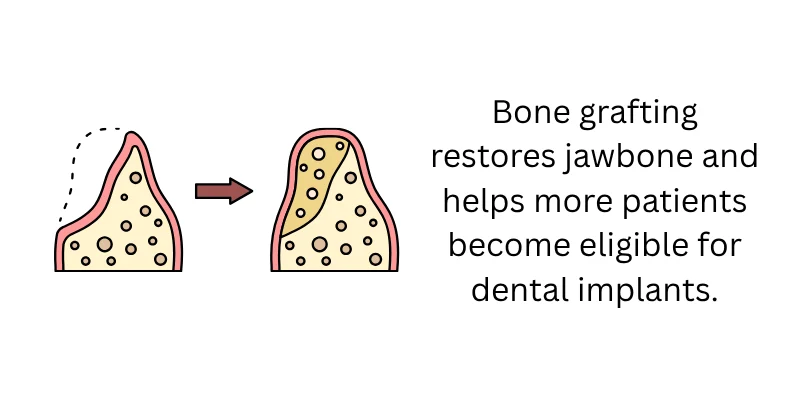
One of the most important developments in modern dentistry is the use of bone grafting to facilitate dental implant treatment.
When a tooth is lost, the jawbone in that area begins to resorb (shrink) over time due to lack of stimulation.
Many patients, especially those who have been missing teeth for years or who had advanced gum disease, do not have enough bone left to securely anchor an implant.
That’s where bone grafting comes in: a graft procedure rebuilds and fortifies the bone, creating a stable foundation for implant placement.
National Demand for Bone Grafts: In 2026, bone grafting is practically a routine part of implant care in the United States. It’s remarkable how common this once-specialized procedure has become.
As implant usage expands to more patients, it naturally includes those with greater bone loss (such as long-term denture wearers or those with chronic periodontal disease).
Additionally, dentists have become more proactive about grafting, often performing socket preservation grafts right after a tooth extraction to prevent future bone shrinkage.
By 2026, the mindset is “graft early and as needed” to ensure that no patient is left without implant options due to a lack of bone.
Bone grafting procedures themselves have advanced significantly.
Doctors can use a variety of graft materials, including a patient’s own bone, processed donor bone, or synthetic biomaterials, sometimes enhanced with growth factors or platelet-rich plasma to accelerate healing.
Techniques like sinus lifts (to add bone in the upper jaw for implants in the molar area) and ridge augmentation (to widen a thin jaw ridge) are now common in oral surgery practices across the country.
The result: many patients who once would have been told they are “not implant candidates” can now receive implants after grafting. This trend underscores why bone grafting is considered a key prerequisite for successful implants in so many cases.
Bone Grafting in Greenville: Locally, Greenville’s dental professionals are fully on board with the bone grafting trend.
The city’s oral surgeons and periodontists perform bone grafts on a daily basis, whether it’s minor grafting during a tooth extraction or complex ridge reconstructions.
Greenville patients benefit from access to modern grafting materials and expertise comparable to any major metropolitan area.
In addition, a number of general dentist offices in Greenville have trained to do straightforward graft procedures (like socket preservation grafts) in-house.
This means that even at the neighborhood family dentist, if you need an extraction, they might place a bone graft material in the socket to help ensure you have enough bone for a future implant.
Such integration of grafting into routine care speaks to its high demand and acceptance.
By 2026, bone grafting is practically standard practice in implant treatment plans, both nationally and in Greenville.
Patients are increasingly aware that if they want an implant, they might need a preliminary bone-building step, and they are open to it, seeing it as an investment in a lasting solution.
Considering a dental implant in Greenville? Book a visit to learn more about bone grafting and how it can help you get the best results from your dental implant procedure.
Dental Implant Demand and Adoption Trends
Dental implants have transitioned from a niche solution to the gold standard for replacing missing teeth. In the mid-20th century, implants were rare and experimental; by the early 2000s, they were available but not widely utilized.
Now, in 2026, we’re witnessing what can only be described as the implant revolution in dentistry. The demand for implants is booming across the United States, and the numbers tell the story.
Nationwide Trends: Millions of dental implants are being placed each year in the U.S., and the trajectory is still sharply upward.
The Cleveland Clinic reports that American dental providers collectively place over 3 million implants per year in recent years.
Every indication is that this volume is higher in 2026 and will continue to grow annually.
Industry analysis indicates the dental implants and prosthetics market is expanding rapidly, with projections that it will grow to around $18.79 billion by 2030 at an approximate 8.4% CAGR, reflecting strong demand driven by an aging population and adoption of advanced dental technologies.
This growth is fueled by several factors converging: an aging population with more tooth loss, greater awareness of implants as a preferable option, improved technology making implants safer and more accessible, and rising disposable incomes/insurance coverage for dental procedures.
But beyond dollars and volumes, consider adoption rates among patients. Dental implants used to be predominantly for the well-to-do or those who absolutely couldn’t tolerate dentures. Now they are mainstream.
A look at prevalence data reveals how rapidly implants have penetrated the market.
Research shows that the prevalence of U.S. adults aged 50+ with at least one dental implant rose from about 1.3% in 1999–2004 to approximately 8.4% in 2015–2020, reflecting substantial growth in implant utilization over the past two decades.
In fact, a landmark study projects that dental implant prevalence among U.S. adults with missing teeth could reach nearly 23% by 2026. Put simply, implants are no longer unusual, but they’re becoming a common part of dental care for millions of people.
Several trends underpin this surge in adoption. First, implants are highly successful, with research showing overall survival rates around 97.8%, and patients have grown confident in them as a permanent solution.
Second, the inconvenience and downsides of traditional dentures or bridges (such as slippage, discomfort, or damaging adjacent teeth) make implants very appealing by comparison.
Third, public awareness has grown: by 2026, most people know someone, either a friend, a colleague, a relative, who has dental implants and raves about the outcome. This social proof lowers barriers for new patients.
Finally, clinicians have gotten better at offering implants to a wider pool of candidates, aided by bone grafting and by advances like digital implant planning and minimally invasive techniques.
All these factors contribute to what can be described as a wave of implant adoption sweeping the country.
Local Trends in Greenville: Greenville, SC exemplifies these national trends on a local scale.
As a regional hub with a sizable retiree population as well as younger professionals, Greenville has experienced a marked uptick in implant dentistry cases.
Local dental practices report that more patients than ever are asking about or choosing implants to replace missing teeth.
Whether it’s a single tooth lost to an accident in a 30-year-old, or a 70-year-old tired of loose dentures seeking a full arch of implant-supported teeth, the interest is high across age groups.
In Greenville’s dental community, implants are seen as the standard of care for eligible patients, and word-of-mouth in the community has further boosted their popularity (“My implant feels just like a real tooth. You should get one!” is a common refrain).
One measure of this demand is the growth of specialized implant centers and services in the area.
Over the past few years, Greenville has welcomed multiple implant-focused dental clinics, including nationally franchised practices and local groups that brand themselves around dentures and implants.
Additionally, many general dentists in Greenville have pursued additional training to place implants themselves or have partnered with traveling implant specialists, so they don’t have to refer patients out.
The result: if you live in Greenville and need an implant in 2026, you have a wealth of options. Implants have gone from a rare referral to the big-city oral surgeon, to an available service at many neighborhood dental offices.
This local adoption trend aligns with the national picture. Implants are becoming as routine as crowns or root canals in treatment plans.
It’s worth noting that the demand isn’t just driven by vanity or convenience; it’s also health-related.
Patients and providers alike in Greenville recognize that replacing missing teeth with implants can preserve jawbone (preventing the sunken facial appearance of long-term denture wearers), restore proper chewing function and nutrition, and improve overall quality of life.
Thus, the rising implant demand is part of a broader emphasis on whole-person health and longevity, consistent with national health trends.
Ready for a new smile? If you’re considering dental implants in Greenville, SC, book a consultation today to explore your options with experienced dental professionals.
Provider Landscape: Greenville’s Services vs. National Averages
The boom in implants and bone grafting demand has prompted a parallel expansion in provider capabilities, both nationwide and in local markets like Greenville.
A key question is: How many dentists or clinics are actually offering these advanced services, and how does Greenville compare to the broader U.S. in this regard?
National Provider Availability: Throughout the United States, more dental professionals are involved in implant therapy than ever before.
Traditionally, dental implants were the domain of specialists (oral surgeons, periodontists, prosthodontists). In 2026, those specialists are still central.
Virtually all oral surgery and periodontal practices offer dental implant placement and associated grafting routinely.
What’s changed is the involvement of general dentists. Many general dentists have now incorporated implant surgery into their skill set, reflecting a significant shift.
The remaining general dentists often restore implants (placing the crown on an implant post placed by a specialist) even if they don’t do the surgical placement. In short, the majority of dental practices nationwide are now engaged in dental implant treatment in some form.
Bone grafting, likewise, has spread beyond specialists; many general dentists perform minor grafts, and of course specialists handle the more complex augmentation cases.
This widespread provider adoption means the average American has much better access to implant care close to home than a decade ago.
According to dental workforce data, the U.S. has over 200,000 practicing dentists, and implant training has become commonplace in continuing education. Even in smaller towns, you might find a local dentist advertising implants.
That said, urban and suburban areas still have greater provider density and often more comprehensive services.
Large dental service organizations (DSOs) and implant clinic chains have also emerged, some operating in multiple states, further increasing the availability of implant and grafting services to the public.
Greenville’s Provider Scene: Greenville, despite being a mid-sized city (~70,000 in the city, around 500,000 in the county), punches above its weight in dental services.
The city boasts a strong contingent of dental professionals: general dentists, dental specialists, and multi-location dental groups all serve the area.
When it comes to offering implants and bone grafting, Greenville’s providers are very much in line with national trends, if not slightly ahead, given the city’s growing, health-conscious population.
By 2026, dozens of dental practices in Greenville advertise dental implants and related surgeries.
This includes at least 8–10 oral and maxillofacial surgeons and periodontal specialists in the vicinity who focus on implants (places like Carolinas Center for Oral Surgery, Periodontics of Greenville, and others), as well as numerous general dentistry offices that highlight implant services in their marketing.
A quick local search will reveal many practices with phrases like “Implant Dentistry” or “Dental Implants in Greenville” on their websites, underscoring how common the offering has become.
In terms of numbers, if Greenville County has on the order of a hundred general dentists, it’s reasonable to say that scores of those dentists are involved in implant treatment, whether by placing them or by restoring them.
The provider-to-population ratio for dentists in Greenville is quite favorable (South Carolina has around 4,400 residents per general dentist on average, and urban centers like Greenville typically have even more dentists per capita than rural areas).
This density, coupled with the high uptake of implant training, means Greenville residents enjoy readily accessible implant care.
In fact, Greenville has attracted some regionally known implant specialists, for example, clinics that do “All-on-4” full-mouth implant restorations, drawing patients from smaller towns across Upstate South Carolina.
Comparing Greenville to national averages, a few points stand out:
- Percentage of Practices Offering Implants: Greenville likely matches or slightly exceeds the national rate. With various general dentists nationwide placing implants, Greenville’s cohort of progressive general dentists fits that pattern.
It’s common to find even family-run Greenville offices that include implant surgery and bone grafts on their service list, a testament to local demand and dentist adoption. - Use of Advanced Techniques: Greenville providers keep up with the latest techniques similar to peers in larger cities. For instance, some Greenville dental surgeons utilize 3D cone-beam CT scans and computer-guided implant surgery for precision, again reflecting the national standard of care for implants in 2026.
Bone graft materials and technology (such as growth factor membranes or stem-cell allografts) found in Greenville clinics are on par with those used anywhere in the U.S. - Multi-Disciplinary Collaboration: Nationally, implant dentistry often involves collaboration (a surgeon places the implant, a general dentist or prosthodontist makes the crown or denture). In Greenville, there is a healthy network of referrals and teamwork.
Many general dentists refer implant surgeries to local specialists and then restore the implants themselves, just as is done across the country.
Conversely, some larger practices in Greenville have in-house specialists or traveling surgeons so that everything is done under one roof, a model also seen more and more nationally.
Greenville’s dental community, being tight-knit, has established these relationships to ensure patients get comprehensive care.
Looking for dental implants in Greenville, SC? Reach out to our expert team today to explore your options for implant procedures and bone grafting services.
Conclusion
The dental implant statistics 2026 finds the United States in a dual reality regarding tooth loss and tooth replacement: on one hand, millions of Americans are still losing teeth, which is a pervasive health issue driven by decay, gum disease, and other factors; on the other hand, we have unprecedented solutions at our disposal, with dental implants offering a durable, lifelike replacement and bone grafting enabling even the most complex cases to be treated.
This guide’s comparison between the national picture and Greenville, SC illustrates that what’s happening broadly is also happening locally.
Tooth loss remains a common affliction in communities like Greenville, but the response, which is a surge in implant dentistry and the necessary preparatory techniques, is meeting the challenge.
For Greenville residents specifically, the convergence of national trends with local initiative means they benefit from high-quality care close to home.
The prevalence of tooth loss among Greenville’s seniors and adults reinforces why these advanced services are so important.
Fortunately, the city’s dentists and specialists have risen to the occasion, ensuring that Greenville keeps pace with the dental innovations seen across the country.
Patients in the Upstate can choose from a range of providers for implants, and they can do so with confidence that bone grafting and other supporting procedures will be available to make their new teeth a success.
In the bigger picture, the story of tooth loss and its remedies in 2026 is one of progress.
While prevention efforts continue (and need to continue, ideally fewer people should lose teeth in the first place in coming years), those who do suffer tooth loss have far better options than past generations.
The acceptance of dental implants as the preferred tooth replacement and the integration of bone grafting into routine practice have together improved oral health outcomes and quality of life for countless individuals.
As we’ve seen, this is as true in the communities of South Carolina as it is nationwide.
The trajectory moving forward is encouraging: we can expect that by the end of this decade, even more Americans, whether in major cities or smaller towns, will keep their smiles intact, either by preserving their natural teeth longer or by replacing lost ones with implants that feel just as real.
References:
- ACP – Missing Tooth
- CDC – About Tooth Loss
- America’s Health Rankings – Teeth Extractions – Age 65+ in South Carolina
- Cleveland Clinic – Dental Implants
- Markets and Markets – Dental Implants and Prosthetics Market
- PubMed – Implant and implant restoration trends among adults 50 years and older in the United States
- PubMed – Trends in Dental Implant Use in the U.S., 1999-2016, and Projections to 2026
- PubMed Central – Dental Implant Survival Rates: Comprehensive Insights from a Large-Scale Electronic Dental Registry