


You want a full, stable smile that fits your jaw and lifestyle. Choosing four implants or adding more can change comfort, strength, and long-term fit.
When your jaw needs extra support or tailored placement, All-on-X with more implants often gives better stability and a more personalized result than the fixed All-on-4 approach.
If your bone is healthy and your needs are simple, four implants can work well and speed treatment.
If you have bone loss, complex bite forces, or want a highly customized plan, adding implants lets your dentist place hardware where it will hold best and reduce future risks.
Key Takeaways
- More implants can improve stability and custom fit for complex jaws.
- Four implants suit many straightforward cases and speed treatment.
- The right choice depends on your bone, bite, and long-term goals.
Schedule a Full Arch Implant Consultation in Greenville South Carolina at The Smile Company
What Are All-on-4 and All-on-X Dental Implants?
Both options replace all teeth in a jaw with a fixed bridge supported by implants. One uses a set four-implant protocol; the other lets your dentist add implants (usually 4–6) to match your bone, bite, and goals.
Definition and Key Concepts
All-on-4 dental implants use exactly four implants per arch to hold a fixed prosthesis. Two front implants are usually placed vertically, and two rear implants are angled to use available bone and avoid grafting.
This gives you same-day temporary teeth in many cases and a predictable plan when your jaw anatomy fits the protocol.
All-on-X dental implants let your dentist use more than four implants (often five or six) when your bone volume, bite forces, or esthetic needs demand extra support.
Your plan is customized with 3D imaging and guided surgery. The final bridge can be acrylic for a temporary or zirconia for a durable, esthetic permanent restoration.
Historical Development in Implant Dentistry
The All-on-4 concept became widely known in the early 2000s as a way to restore a full arch with fewer implants and less need for bone grafting.
Clinicians showed it could deliver reliable function and same-day provisional teeth, which made full-arch restoration faster and more accessible.
All-on-X evolved from that idea as clinicians gained better imaging, planning software, and implant systems. You now see flexible full-mouth dental implants plans that tailor implant number and position to each patient.
This shift lets implant dentistry handle patients with more bone loss or stronger bite forces without defaulting to grafts or complex procedures.
Speak With a Greenville South Carolina Implant Dentist About All On 4 vs All On X
Comparing All-on-4 and All-on-X: Implant Number and Placement
You will learn how implant count and position change strength, chewing comfort, and when extra implants make sense. Pay attention to bone volume, jaw shape, and the forces your bite creates.
Number of Implants Used
All-on-4 uses exactly four dental implants per arch. Two implants go in the front and two are placed posteriorly at an angle. This setup often avoids bone grafts and lowers cost while still supporting a fixed prosthesis.
All-on-X lets your clinician use 4, 5, 6, or more implants based on your jaw structure and bone volume.
Adding implants can reduce load per implant and improve long-term stability when your chewing force is high or bone is weak. For example, an All-on-6 distributes stress more evenly than four implants.
Considerations for you:
- If bone volume is limited in the back, four tilted implants may suffice.
- If you have a strong bite or bruxism, more implants may be safer.
- More implants usually mean higher upfront cost and longer surgery.
Implant Placement and Angulation
Placement in All-on-4 follows a predictable pattern: two vertical anterior implants and two angled posterior implants. Angulation lets the posterior implants use denser anterior bone and avoid sinus or nerve areas.
With All-on-X, placement becomes tailored. Your surgeon plans implant sites using CBCT scans and surgical guides to match your jaw anatomy.
Angulation still matters, but you may get more vertical posterior implants if bone volume allows.
Key technical points for you:
- Tilted implants extend prosthetic support toward the back without grafting.
- Vertical posterior implants need sufficient bone height and density.
- Guided surgery improves accuracy for both methods, reducing fit problems and mechanical stress.
Distribution of Occlusal Forces
How your bite force spreads across implants affects prosthesis longevity. Four implants concentrate occlusal load into fewer points, which can increase stress per implant during chewing, especially with hard foods or strong bites.
Increasing implant number spreads chewing force across more fixtures. An All-on-6 or All-on-8 lowers per-implant load and can reduce screw loosening, implant overload, and prosthetic fractures.
This helps if you eat tough foods, grind your teeth, or have low bone density.
Practical advice:
- Ask how many implants will share posterior chewing load.
- Check whether the planned prosthetic design gives even contact across the arch.
- Discuss protective measures (night guards, phased loading) if you have heavy bite forces.
Compare Full Arch Dental Implant Options With a Specialist
Customization and Flexibility: When More Implants Make a Difference
Adding implants can change how your full-arch plan fits your jaw, bite, and goals. More implants let your provider spread load, avoid weak bone, and design a bridge that suits your chewing force and esthetic needs.
Personalized Treatment Planning
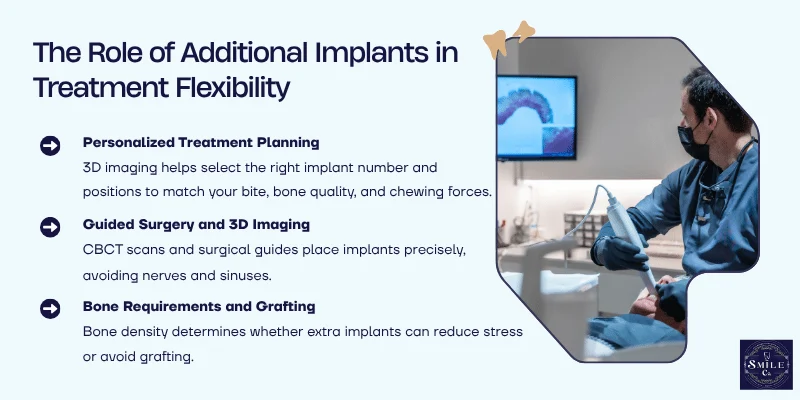
Your provider will use a clinical exam and 3D imaging to map your jaw. That lets them choose exact implant number and positions that match your bite and bone quality.
If you grind your teeth or need stronger chewing zones, placing five or six implants can reduce stress on each implant and on the final bridge.
Treatment planning lists decisions clearly: implant count, implant type, bridge material, and whether immediate teeth are safe.
You’ll get a digital or printed plan showing implant locations and a timeline for surgery, temporary prosthesis, and final restoration. This plan reduces surprises and helps you compare costs and risks.
Guided Surgery and 3D Imaging
You get a CT or CBCT scan that shows bone density and anatomy in 3D. That imaging feeds into guided surgery software so implants land precisely where planned.
A surgical guide (made from your scan) controls angle and depth during placement to avoid nerves and sinuses.
Full-arch guided surgery improves accuracy when you choose more implants. Guides let the surgeon place extra implants in narrow or angled bone safely.
Guided workflows also let labs prefabricate temporary bridges that fit on the same day, when conditions allow.
Bone Requirements and Grafting
Bone density and quality drive whether more implants help. If your posterior bone is weak, adding implants in denser areas can reduce the need for bone grafting.
Conversely, severe bone loss may still require grafts or alternative implants (like zygomatic) even with an All-on-X plan.
Your scan will show bone height and width at each site. If a graft is needed, the plan will state graft type, timing (simultaneous or staged), and how it affects healing time.
Choosing five or six implants may avoid grafts by using available dense bone, but your clinician will explain trade-offs for long-term stability.
Prosthetic Support and Restoration Options
You’ll choose between temporary and permanent prostheses, materials that affect strength and wear, and designs that change cleaning and long-term oral health.
The number and placement of implants change how the prosthesis is supported, how it looks, and how it’s maintained.
Temporary vs. Permanent Prostheses
Temporary prosthesis (temporary teeth) are placed right after implant surgery to restore function and appearance while osseointegration occurs.
They are usually acrylic on a milled or cast metal base and are lighter and easier to adjust. You’ll rely on the implants for initial support, but the temporary restoration is not meant for long-term chewing forces.
Permanent prostheses replace temporaries after healing. Options include fixed full-arch bridges or screw-retained frameworks that attach to four or more implants.
These use stronger materials and precise fit to carry full chewing loads. If you choose All-on-4, your permanent bridge may have longer cantilevers; with All-on-X or All-on-6, the extra implants allow shorter cantilevers and more even force distribution.
Talk with your clinician about repairability: many fixed permanent prostheses are serviceable (individual teeth or segments can be replaced) without removing the whole framework.
Prosthetic Materials and Durability
Common materials for final prostheses include acrylic over a metal or titanium subframe, zirconia, and layered porcelain. Acrylic is cost-effective, lighter, and easier to repair, but it wears faster and stains.
Zirconia is harder, resists wear and staining, and offers a more natural look, but it can be brittle and harder to repair if it fractures.
Metal-supported acrylic blends strength and reparability. Full-contour zirconia or hybrid zirconia-porcelain gives superior aesthetics and longevity when supported by enough implants.
More implants (All-on-X) let you use rigid designs like full-zirconia with less risk of flexing. Ask about expected lifespan, how often parts may need replacement, and whether the lab can make repairs locally.
Impact on Oral Health and Aesthetics
Prosthetic support affects bone load, hygiene access, and gum appearance. When implants spread forces evenly, you reduce bone stress and help preserve marginal bone during osseointegration and long-term function.
More implants can lower the chance of prosthetic overload and may protect against chipping or framework failure.
Aesthetics depend on prosthetic design and material. Full-arch restorations on four implants can look excellent, but more implants let technicians shape emergence profiles and gum contours more precisely.
Hygiene matters: screw-retained designs let you remove the prosthesis for cleaning or repairs, while fixed, non-removable options require disciplined home care and regular professional maintenance to protect oral health.
Clinical Considerations and Patient Suitability
You need a treatment that fits your jaw shape, bone health, budget, and daily needs. These options differ mainly by implant count, how they spread bite forces, and whether they avoid bone grafting.
Ideal Candidates for All-on-4
All-on-4 often suits you if you have moderate bone loss in the back of the jaw but usable bone in the front. Dentists place two straight front implants and two angled back implants to use available bone without grafting.
This approach can let you get a fixed prosthesis faster and at lower initial cost than adding more implants. It also reduces surgical time and recovery for medically fragile patients.
Expect limits: if your bite force is very strong or your bone quality is poor, the four implants may face higher risk of implant overload over time.
Your dentist will evaluate bone density and quality with scans to confirm that four implants can carry your prosthesis safely.
Who May Benefit from All-on-X
All-on-X helps when your jaw needs more implant support to spread chewing forces or when bone density is uneven. Adding implants (5–8) gives better load distribution, which lowers the chance of implant overload and can improve long-term stability.
Choose All-on-X if you clench, chew hard foods, have larger prosthetic spans, or want added redundancy so a single implant issue won’t threaten the whole arch.
This option can require more planning and surgery and may increase cost. You may still avoid bone grafting depending on implant placement and your bone map. Discuss how many implants make sense for your bite and lifestyle.
Bone Loss and Jaw Challenges
Your jaw’s bone loss, density, and quality drive the plan. Low bone height in the back often pushes clinicians to angle implants or add more implants toward the front.
Bone density affects how well implants integrate; poor density raises failure risk.
If your bone is thin, options include angled all-on-4 placement, extra implants (all-on-X), or bone grafting. Each choice changes surgery time, cost, and recovery.
Dentures differ here: removable dentures rest on soft tissue and don’t stop bone loss. Fixed implant prostheses (All-on-4/All-on-X) help preserve bone by transferring chewing forces to bone, but only if implants are placed where bone quality supports load.
Your clinician will use CT scans to map bone and plan implant number and position to avoid overload and protect long-term outcomes.
Long-Term Outcomes and Choosing the Right Option
You’ll weigh how well the implants hold up over years and how much care and cost each path requires. Focus on implant survival, bone health, and how the number of implants affects maintenance and recovery.
Long-Term Stability and Maintenance
More implants usually spread chewing forces across your jaw, which can reduce stress on each implant and lower the risk of screw or bone complications.
For example, an All-on-6 setup often gives better load distribution than All-on-4, which can matter if you have heavy bite forces or reduced bone volume.
Keep these maintenance points in mind:
- Brush twice daily and use interdental brushes to clean around implant bars and abutments.
- Schedule professional cleanings every 3–6 months depending on your gum health.
- Stop smoking and control conditions like diabetes to improve osseointegration and long-term survival.
Check your prosthesis regularly for wear. Materials like zirconia resist wear and show less marginal bone loss over time compared with some acrylic hybrids.
Talk with your dentist about which prosthetic material fits your chewing habits and long-term goals.
Cost, Recovery, and Treatment Timeline

All-on-4 usually costs less and has a shorter surgery time because it uses four implants and often avoids bone grafts. Expect a single-arch price range that is generally lower than an All-on-X plan that adds implants and may need extra surgical time.
Ask your clinic for an itemized estimate that lists implants, temporary prosthesis, final prosthesis, imaging, and follow-ups.
Recovery timeline steps you should expect:
- Surgery and placement of a temporary prosthesis (same day in many cases).
- A 3–6 month osseointegration period with soft diet limits.
- Final prosthesis placement once integration and healing are confirmed.
If your plan requires bone grafting or additional implants, add 3–9 months to the timeline. Also plan for periodic maintenance visits; more implants can mean slightly longer cleanings but often fewer mechanical failures long term.
Frequently Asked Questions
This section answers how implant count changes load sharing, risks of the All-on-4 method, factors that steer you toward 4 versus 6–8 implants, upkeep differences, cost trade-offs, and specific clinical situations where extra implants matter.
How does the number of implants affect the success and stability of full arch restorations?
More implants spread biting forces over a larger area, lowering stress on each implant and on the jawbone. That can improve long-term stability and reduce the chance of implant overload.
Adding implants can also allow shorter cantilevers or more even tooth support, which helps when you chew hard foods or have a strong bite.
If your bone is thin or uneven, extra implants let the surgeon place them where bone is best, improving anchorage.
What are the potential risks and complications associated with All-on-4 dental procedures?
Surgical risks include infection, bleeding, swelling, and pain. Implants placed at an angle can risk nerve or sinus involvement if planning or placement is poor.
Prosthetic problems may include screw loosening, prosthesis fracture, or wear of the denture teeth. Long-term risks include bone loss around implants and peri-implantitis, especially if oral hygiene and regular dental visits lapse.
What key factors should a patient consider when choosing between All-on-4 and All-on-6 or All-on-8 treatments?
Check the amount and quality of your jawbone on CBCT imaging; less bone or uneven bone may favor more implants. Consider your bite force and whether you grind or clench, which raises mechanical demands.
Review medical history like smoking, diabetes, or osteoporosis that affect healing. Ask about expected prosthesis design, cantilever length, and whether the plan uses guided surgery or digital planning for precise placement.
Could you explain the maintenance requirements for All-on-4 implants compared to other full arch solutions?
You must clean under and around the prosthesis daily with floss, interdental brushes, or water flossers.
Professional checkups and hygienist visits every 3–6 months are common to monitor implants and remove buildups.
If you have more implants, hygiene access can be easier because load is lower per implant, but you still need the same daily routine and regular professional care.
How does the cost of All-on-4 procedures generally compare with those involving more dental implants?
All-on-4 usually costs less up front because you use four implants and a simpler prosthesis. Adding implants raises surgical time, material costs, and lab fees, so All-on-6 or All-on-8 is typically more expensive.
Higher initial cost can sometimes buy greater long-term stability and fewer repairs, but cost-benefit depends on your bone, bite, and lifestyle.
Are there specific cases or conditions where more implants might be necessary over the All-on-4 approach?
Yes. Severe bone resorption, especially when anterior bone is inadequate, often requires more implants for support. Patients with heavy bite forces, bruxism, or large cantilevers may need extra implants to reduce mechanical stress.
Also consider cases with previous implant failure, complex anatomy, or when you want a fixed prosthesis with greater rigidity; placing more implants can give the team better options during planning and restoration.